<?xml version="1.0" encoding="utf-8"?><feed xmlns="http://www.w3.org/2005/Atom" ><generator uri="https://jekyllrb.com/" version="4.3.4">Jekyll</generator><link href="https://sportstechwest.com/index.xml" rel="self" type="application/atom+xml" /><link href="https://sportstechwest.com/" rel="alternate" type="text/html" /><updated>2026-11-07T03:12:57+00:00</updated><id>https://sportstechwest.com/index.xml</id><title type="html">SportsTechWest</title><subtitle>A blog exploring the journey from professional athlete to sports tech vagabonder, at the intersection of sport, science and technology.</subtitle><author><name>Rashad West</name></author><entry><title type="html">I Have Called Myself a Translator for Years. Sports Has a Translation Gap.</title><link href="https://sportstechwest.com/blog/i-have-called-myself-a-translator-for-years/" rel="alternate" type="text/html" title="I Have Called Myself a Translator for Years. Sports Has a Translation Gap." /><published>2026-07-21T00:00:00+00:00</published><updated>2026-07-21T00:00:00+00:00</updated><id>https://sportstechwest.com/blog/I-Have-Called-Myself-a-Translator-for-Years</id><content type="html" xml:base="https://sportstechwest.com/blog/i-have-called-myself-a-translator-for-years/"><![CDATA[<h2 id="i-have-called-myself-a-translator-for-years">I Have Called Myself a Translator for Years</h2>

<p>Playing overseas, my coach sat me down with Steve Nash film and showed how Nash used the referee lanes to create angles on the court. That was the moment I saw basketball as math in motion: lanes, spacing, geometry, decisions.</p>

<p>From then on, I have used sport to build curriculum, analytics tools, and games.</p>

<p>I have called myself a translator for years.</p>

<p>Not because I speak for data scientists or speak down to athletes. I use the word because much of my career has taken place between different basketball worlds.</p>

<p>I have been the player receiving information. I have trained young athletes trying to understand their development. I have worked with NBA teams on player-tendency and analytics questions. I have helped people around the game, including families of NBA players, understand what analytics mean and how they connect to development.</p>

<p>At the end of the day, analytics are tendencies. The numbers are accumulated evidence that help us see those patterns more clearly.</p>

<p>The tools have changed. The job has remained the same.</p>

<p>Turn complexity into understanding. Then turn understanding into action.</p>

<p>I wrote about this role in 2020, when I called Sportstechwest an analytics translator. The title was not a marketing line waiting for a trend. It described the gap I kept seeing between measurement and meaning.</p>

<p>The need has been there longer than the language.</p>

<hr />

<h2 id="the-real-problem-is-not-more-data">The Real Problem Is Not More Data</h2>

<p>Organizations now have more dashboards, automated clips, sensor outputs, and ways to grade a possession than most staffs can absorb in a week.</p>

<p>College programs also operate inside regulated time. Under <a href="https://web3.ncaa.org/lsdbi/reports/pdf/searchPdfView?businessCode=BYLAW_SEARCH_VIEW&amp;id=1567">NCAA Division I Bylaw 17.1.7.1</a>, student-athletes may spend no more than four hours per day and twenty hours per week on countable athletically related activities during the playing season. Required film sessions and technology walkthroughs can fall within that limit when they are directed or supervised by coaching staff.</p>

<p>That constraint matters. Every minute spent explaining a dashboard competes with practice, recovery, and the rest of a student-athlete’s life.</p>

<p>More information does not automatically produce more understanding.</p>

<p>Sometimes it creates longer meetings, conflicting interpretations, athlete confusion, and reports that never become a clear next action.</p>

<p>The missing piece is often training. People need reps that teach them how to recognize a tendency and act on it.</p>

<p>Sports does not have a data shortage. It has a translation gap.</p>

<hr />

<h2 id="what-a-translator-actually-does">What a Translator Actually Does</h2>

<p>A translator does not make analytics less intelligent.</p>

<p>A translator protects what is true while making it usable for a specific audience.</p>

<p>An analyst may see a statistically meaningful pattern. A coach may see a tactical problem. A player may hear criticism.</p>

<p>The job is to decide which tendency matters, show it clearly, and communicate it in basketball language.</p>

<p>I call that skillset Hoop Tendency Expertise. Hoop Tendency Experts see patterns early and turn them into cues athletes can use.</p>

<p>BallCODE is the product. The skill is separate.</p>

<div class="text-center my-4">
  <img src="https://sportstechwest.com/assets/images/blog-img/translator-analytics-terms.jpg?v=20260724a" alt="The Translation System: Sportstechwest, BTE Analytics, BallCODE, and BallCODEChess" class="img-fluid" />
</div>

<p>Coaches need tactical and developmental meaning. Players need clear cues and behaviors they can test. Analysts need confidence that the finding still holds after it has been translated.</p>

<p>That is not watering down analytics.</p>

<p>It is completing the work.</p>

<hr />

<h2 id="i-did-not-learn-this-from-one-title">I Did Not Learn This From One Title</h2>

<p>I did not learn this from one title.</p>

<p>I learned it from different sides of the game:</p>

<ul>
  <li>Playing professionally and receiving information during live competition.</li>
  <li>Training young athletes and connecting measurements to development.</li>
  <li>Testing products, building models, and working through analytics questions with teams.</li>
</ul>

<p>Through BTE Analytics, that work moved into early innovation pilots with NBA teams.</p>

<p>People around the game still ask me to put analytics into human language. Professors now ask what I am seeing in sports technology.</p>

<p>Each setting looks different. The skill is the same.</p>

<hr />

<h2 id="what-ballcode-is">What BallCODE Is</h2>

<p>BallCODE is how I turned that translation work into a learning system.</p>

<p>It starts with basketball: stories, decisions, and if/then choices. That familiar language becomes a bridge into analytics, logic, coding, and decision-making.</p>

<p>Coding, in this context, means thinking like a computer. Break a task into clear steps, understand the conditions, and decide what happens next.</p>

<div class="text-center my-4">
  <img src="/assets/images/blog-img/translator-analytics-whiteboard.jpg" alt="Coach and player reviewing lanes and angles on a whiteboard beside a tablet court diagram" class="img-fluid" />
</div>

<p>We usually introduce BallCODE to younger learners. The same thinking matters for coaches and athletes at every level.</p>

<hr />

<h2 id="a-practical-coaching-principle">A Practical Coaching Principle</h2>

<p>Working memory is limited. Poorly organized instruction creates unnecessary load.</p>

<p>Film works best when the coach defines its purpose and directs attention toward what matters.</p>

<p>HoopStudy’s breakdown of paint touches is a clear example: <a href="https://www.youtube.com/watch?v=_H-LD2iDe5g">Get EASIER BASKETS with analytics</a>. It moves from a statistic to film, then from film to decisions a player can execute: finish, drop to a big, hit a cutter, or kick out for an open three.</p>

<p>That is translation. The work is incomplete until the player understands the next action.</p>

<p>I use a flexible coaching loop:</p>

<ul>
  <li>A focused observation.</li>
  <li>A small number of relevant clips.</li>
  <li>One clear cue.</li>
  <li>One behavior to test.</li>
  <li>A follow-up measurement.</li>
</ul>

<p>The number of clips will vary. The principle does not.</p>

<p>Less footage. Clearer direction. Focused film and one actionable instruction beat a highlight dump that leaves everyone nodding and nobody changing.</p>

<hr />

<h2 id="why-this-skill-matters">Why This Skill Matters</h2>

<p>Assistant coaches do not all need to become programmers or data scientists.</p>

<p>They need enough analytical literacy to ask better questions, challenge weak conclusions, and communicate an insight in basketball language.</p>

<p>Math still matters for advanced models and for checking the work. Analysts protect the measurement. People who see the pattern and explain the cue help the organization use it.</p>

<p>Not instead of analysts.</p>

<p>Alongside them.</p>

<p>That combination gives the staff confidence in the number and clarity in the cue.</p>

<p>That is the job.</p>

<hr />

<h2 id="ballcodechess-and-the-reps-that-make-it-stick">BallCODEChess and the Reps That Make It Stick</h2>

<p>BallCODEChess is the competitive layer of BallCODE.</p>

<p>We use robots and controlled objects to make a situation easier to define, repeat, and code. That structure helps learners see the pattern before applying it to a fluid human game.</p>

<div class="text-center my-4">
  <video class="player img-fluid" playsinline="" controls="" preload="metadata" style="max-width:100%;">
    <source src="/assets/media/ballchess-teaser-v1.mp4?v=20260723f" type="video/mp4" />
  </video>
  <p class="text-muted mt-2"><small><em>BallCODEChess teaser. Robots and scenarios as controllable objects for pattern recognition.</em></small></p>
</div>

<p>BallCODEChess tests knowledge mentally in the same way lifting, running, and playing test the body.</p>

<p>Reps. Decisions. Pattern recognition under pressure.</p>

<div class="text-center my-4">
  <img src="/assets/images/blog-img/translator-analytics-ballcode.jpg" alt="Coach and player reviewing a basketball court diagram on a monitor" class="img-fluid" />
</div>

<p>If you lead player development, try one scenario more than once. See whether repeating the same context sharpens the decisions.</p>

<p>Same bridge. Different rooms.</p>

<hr />

<h2 id="the-gap-i-keep-working-to-close">The Gap I Keep Working to Close</h2>

<p>Technology will keep giving sports more footage, measurements, and ways to evaluate performance.</p>

<p>Information alone does not teach.</p>

<p>Someone still has to decide what matters and turn it into a cue an athlete can use.</p>

<p>That has been my work for years.</p>

<p>I translate the game.</p>

<p>Related: <a href="/blog/SportsTechWest_the_Analytics_Translator/">SportsTechWest the Analytics Translator (2020)</a></p>

<ul>
  <li>
    <table>
      <tbody>
        <tr>
          <td>Rashad West</td>
          <td>Sportstechwest</td>
        </tr>
      </tbody>
    </table>
  </li>
</ul>]]></content><author><name>Rashad West</name></author><category term="Insights" /><category term="analytics" /><category term="basketball" /><category term="coaching" /><category term="translation" /><category term="sportstechwest" /><category term="BallCODE" /><category term="player-development" /><summary type="html"><![CDATA[Sports does not have a data shortage. It has a translation gap. Why athlete-informed analytics translators turn numbers and film into cues coaches and players can use.]]></summary></entry><entry><title type="html">The Front-Office Equation: Deconstructing the 2026 NBA Draft Top 5 with Predictive Analytics</title><link href="https://sportstechwest.com/blog/front-office-equation-2026-nba-draft-top-5/" rel="alternate" type="text/html" title="The Front-Office Equation: Deconstructing the 2026 NBA Draft Top 5 with Predictive Analytics" /><published>2026-06-23T00:00:00+00:00</published><updated>2026-06-23T00:00:00+00:00</updated><id>https://sportstechwest.com/blog/Front-Office-Equation-2026-NBA-Draft-Top-5</id><content type="html" xml:base="https://sportstechwest.com/blog/front-office-equation-2026-nba-draft-top-5/"><![CDATA[<p>🏀📊 <strong>The Front-Office Equation</strong></p>

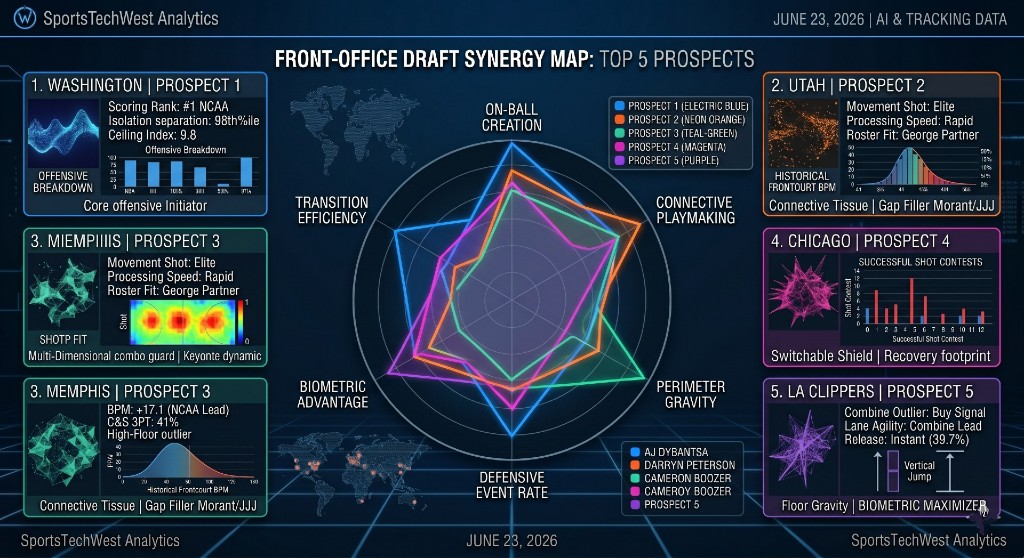
<p>I’ve been digging into <a href="https://www.nba.com/draft/2026"><strong>NBA draft</strong></a> tracking data ahead of tonight — and here’s what’s clear: the era of vibes-based scouting is fading fast. Public boards still lean on traditional media narratives and raw box-score counting stats. Behind closed doors, teams are running machine learning pipelines — tracking-sensor metrics, biometric outlier thresholds, lineup synergy simulators.</p>

<p>As a consensus top-five tier solidifies across major outlets, a quiet analytical divide has emerged. Teams are no longer asking only <em>“Who is the best player available?”</em> They are asking: <em>“Whose statistical signature closes our roster’s structural gaps?”</em></p>

<p>That’s the analytical reality of the top five in the 2026 NBA Draft.</p>

<hr />

<h2 id="the-consensus-board-matrix">The Consensus Board Matrix</h2>

<table>
  <thead>
    <tr>
      <th>Pick / Team</th>
      <th>Prospect</th>
      <th>Position / Build</th>
      <th>Core AI Modeling Catalyst</th>
      <th>Roster Fit Role</th>
    </tr>
  </thead>
  <tbody>
    <tr>
      <td><strong>#1 Washington</strong></td>
      <td>AJ Dybantsa (BYU)</td>
      <td>6’9” Initiator Wing</td>
      <td>Elite spatial separation and 3-level shot creation efficiency</td>
      <td>Franchise 1A Scoring Engine</td>
    </tr>
    <tr>
      <td><strong>#2 Utah</strong></td>
      <td>Darryn Peterson (Kansas)</td>
      <td>6’5” Combo Guard</td>
      <td>High school isolation tracking + college catch-and-shoot processing</td>
      <td>Multi-Dimensional Backcourt Partner</td>
    </tr>
    <tr>
      <td><strong>#3 Memphis</strong></td>
      <td>Cameron Boozer (Duke)</td>
      <td>6’9” Power Forward</td>
      <td>+17.1 Box Plus-Minus outlier; 41% catch-and-shoot 3PT linear regression</td>
      <td>High-IQ Connective Tissue / Spacing Bridge</td>
    </tr>
    <tr>
      <td><strong>#4 Chicago</strong></td>
      <td>Caleb Wilson (UNC)</td>
      <td>6’10” Versatile Forward</td>
      <td>Rare defensive event rates (deflections, blocks, recovery tracking)</td>
      <td>Switchable Defensive Weapon</td>
    </tr>
    <tr>
      <td><strong>#5 LA Clippers</strong></td>
      <td>Split: Wagler / Brown / Acuff</td>
      <td>Variety of Guards</td>
      <td>Biometric and agility outliers vs. transition and release-speed profiles</td>
      <td>High-Volatility Floor Gravity / Playmaker</td>
    </tr>
  </tbody>
</table>

<div class="text-center my-4">
  <img src="https://sportstechwest.com/assets/images/blog-img/nba-draft-2026-hero.png?v=20260623c" alt="The Front-Office Equation — deconstructing the 2026 NBA Draft top 5 by team, prospect, and roster fit role" class="img-fluid" />
</div>

<hr />

<h2 id="interactive-sandbox-front-office-strategy-simulator">Interactive Sandbox: Front-Office Strategy Simulator</h2>

<p>Use our live interactive model below to adjust draft-board philosophy weights. Change the balance between <strong>shot creation</strong>, <strong>defensive event rate</strong>, and <strong>roster synergy</strong> — and watch how AI fit scores recalibrate across this year’s top prospects.</p>

<div class="text-center my-4" style="width:100%; overflow:hidden; border-radius:12px; border:1px solid #1e293b;">
  <iframe src="/Front_Office_NBA_Draft_Dashboard.html" title="Front-Office NBA Draft Simulator" style="width:100%; min-height:720px; border:0;" loading="lazy">
  </iframe>
</div>

<p><strong><a href="https://sportstechwest.com/Front_Office_NBA_Draft_Dashboard.html">Open the simulator full-screen</a></strong> if the embed is cramped on mobile.</p>

<hr />

<h2 id="the-front-office-draft-synergy-map">The Front-Office Draft Synergy Map</h2>

<p>To visualize how these profiles overlap, our modeling engine maps each prospect across five core developmental pillars. Note how the shape of each player’s polygon highlights their unique strategic role:</p>

<div class="text-center my-4">
  <img src="https://sportstechwest.com/assets/images/blog-img/nba-draft-2026-synergy-map.png?v=20260623b" alt="Front-Office Draft Synergy Map — top 5 prospects across on-ball creation, playmaking, gravity, defense, biometrics, and transition" class="img-fluid" />
</div>

<p><em>Washington’s Dybantsa dominates on-ball creation. Memphis’s Boozer fills the connective tissue gap. Chicago’s Wilson spikes defensive event rate. LA’s fracture point at five shows three completely different polygon shapes depending on philosophy.</em></p>

<hr />

<h2 id="three-analytical-truths-in-the-2026-class">Three Analytical Truths in the 2026 Class</h2>

<h3 id="1-aj-dybantsa-is-the-classs-only-true-1a-scoring-hub">1. AJ Dybantsa is the class’s only true 1A scoring hub</h3>

<p>Evaluating high-volume collegiate scorers is a historical minefield. System spacing and usage inflation frequently distort raw field goal percentages. To find the truth, front offices use advanced spatial tracking to isolate scoring efficiency independent of the team’s system.</p>

<p>For AJ Dybantsa, the tracking data reveals something rare. His footwork, deceleration, and hip fluidity produce a <strong>spatial separation metric in the 98th percentile</strong> of all prospects mapped over the last five years.</p>

<p>In plain English: regardless of how tightly he is contested, Dybantsa has a mechanical release that generates clean shot windows. He hits every major usage and physical length threshold that historical models associate with elite playoff initiator wings — think <a href="https://www.basketball-reference.com/players/t/tatumja01.html"><strong>Jayson Tatum</strong></a>-type profiles. For a rebuilding Washington franchise looking for an offensive foundation, he is the mathematically aligned pick.</p>

<h3 id="2-cameron-boozer-is-a-broken-linear-regression--in-the-best-way">2. Cameron Boozer is a broken linear regression — in the best way</h3>

<p>If Dybantsa is the ultimate initiator, Duke’s Cameron Boozer is the ultimate system enhancer. From a pure data-modeling perspective, Boozer is arguably the most bulletproof prospect in the draft.</p>

<p>During his freshman campaign, Boozer posted a <strong>Box Plus-Minus of +17.1</strong> — a mark that firmly places him as a historic front-court outlier.</p>

<p>Predictive regressions that evaluate defensive rebounding alongside high-volume shooting efficiency love this profile. Converting on <strong>41% of catch-and-shoot three-pointers</strong>, he acts as an elite spacing bridge. Roster simulation models show him fitting cleanly into Memphis’s front-court architecture — filling the gap between Ja Morant’s rim pressure and Jaren Jackson Jr.’s perimeter-heavy defense.</p>

<h3 id="3-caleb-wilson-is-a-defensive-event-rate-anomaly">3. Caleb Wilson is a defensive event-rate anomaly</h3>

<p>Traditional scouts evaluate defense by watching blocks and on-ball isolation stops. Computer-vision algorithms evaluate defense by measuring <strong>recovery footprint and lateral event rates</strong>.</p>

<p>At 6’10” with an immense wingspan, North Carolina’s Caleb Wilson registers deflections and quick-switch recoveries at a rate that breaks defensive projection templates.</p>

<p>Tracking data shows Wilson recovering ground out of pick-and-roll drop coverages faster than any forward in this class. His rapid hip rotation lets him switch onto smaller, quicker ball-handlers without yielding penetration lanes. For a Chicago Bulls roster seeking a defensive anchor built for modern, highly spaced NBA schemes, Wilson’s event-rate metrics represent a rare switch-everything weapon.</p>

<hr />

<h2 id="pick-5-volatility-the-clippers-crossroads">Pick #5 Volatility: The Clippers’ Crossroads</h2>

<p>While the top four selections sit in a distinct, mathematically sound tier, the draft fractures at No. 5 with the LA Clippers. Front-office data suggests three vastly different paths:</p>

<p><strong>The biometric arbitrage (Keaton Wagler)</strong><br />
Wagler’s raw combine data — lateral lane agility, vertical leap — tested drastically higher than his consensus media ranking. Front-office algorithms trigger an automatic buy signal here. His ultra-fast catch-and-shoot release (<strong>39.7% from deep</strong>) projects massive off-ball floor gravity.</p>

<p><strong>The transition accelerator (Mikel Brown Jr.)</strong><br />
If the Clippers optimize for pace-and-space transition efficiency, Brown is the target. Advanced tracking metrics profile him as an elite push-ahead passer who consistently forces defenses into cross-matched mismatches.</p>

<p><strong>The pure ceiling gamble (Darius Acuff)</strong><br />
Converting <strong>44%</strong> of high-volume collegiate three-point attempts, Acuff offers a developmental scoring ceiling that could match the top four if his playmaking mechanics stabilize.</p>

<hr />

<h2 id="why-this-matters">Why This Matters</h2>

<p>As draft night approaches, boards keep shifting behind closed doors. Front offices run simulations up until the final hours. By using mathematical profiles rather than tape-only instincts, teams are reducing draft-night variance — turning the lottery from a high-stakes gamble into calculated roster engineering.</p>

<hr />

<h2 id="bottom-line">Bottom Line</h2>

<p>Whether you are watching as a fan or building as an analyst:</p>

<ul>
  <li><strong>Roster fit beats raw talent</strong> when the model is calibrated to your personnel</li>
  <li><strong>Tracking data separates system noise from true skill</strong></li>
  <li><strong>Event rates and synergy sims are the new scouting report</strong></li>
  <li><strong>Pick five is where philosophy wins over consensus</strong></li>
</ul>

<p>Smart front offices do not just pick players. They solve roster equations.</p>

<hr />

<h2 id="big-picture">Big Picture</h2>

<p>The 2026 class is a case study in how <a href="https://www.nba.com/stats"><strong>NBA analytics</strong></a> has moved from the back office to the war room. Spatial separation, Box Plus-Minus outliers, defensive event rates, biometric thresholds — these are not buzzwords. They are the inputs teams use when the clock is running.</p>

<p>Open the simulator, pick an organization, and move the weights. You will see why Washington, Utah, Memphis, Chicago, and LA are not all asking the same question tonight — even if they are staring at the same board.</p>

<hr />

<p><strong>Keywords:</strong> NBA Draft 2026, AJ Dybantsa, Cameron Boozer, Caleb Wilson, Darryn Peterson, NBA analytics, roster fit, tracking data, predictive modeling, front office, SportsTechWest</p>]]></content><author><name>Rashad West</name></author><category term="Insights" /><category term="basketball" /><category term="NBA" /><category term="analytics" /><category term="draft" /><category term="data-science" /><category term="tracking-data" /><summary type="html"><![CDATA[Behind the curtain of modern NBA draft war rooms — how spatial tracking, event-rate algorithms, and roster-fit simulators are reshaping the top five picks in the 2026 class.]]></summary></entry><entry><title type="html">Teaching Is the Greatest Teacher: Helping Entrepreneurs Get Started and Fund Their Ventures</title><link href="https://sportstechwest.com/blog/Building-Entrepreneurs-as-a-VC-Scout/" rel="alternate" type="text/html" title="Teaching Is the Greatest Teacher: Helping Entrepreneurs Get Started and Fund Their Ventures" /><published>2026-03-17T00:00:00+00:00</published><updated>2026-03-17T00:00:00+00:00</updated><id>https://sportstechwest.com/blog/Building-Entrepreneurs-as-a-VC-Scout</id><content type="html" xml:base="https://sportstechwest.com/blog/Building-Entrepreneurs-as-a-VC-Scout/"><![CDATA[<h2 id="teaching-is-the-greatest-teacher">Teaching Is the Greatest Teacher</h2>

<p>Helping entrepreneurs has never been something I planned—it’s been instinctual.</p>

<p>When asked to support founders, I just started helping.</p>

<p>The biggest thing is getting started.</p>

<p>Over the years, I’ve found ways to help individuals:</p>
<ul>
  <li>Start their own businesses</li>
  <li>Build operational systems for growth</li>
  <li>Connect with funding and investors</li>
</ul>

<p>As a VC scout, I connect founders to capital—but that’s one of many ways I help, not the core of what I do.</p>

<div class="text-center my-4">
  <img src="/assets/images/blog-img/vc-scout-hero.jpg" alt="Building entrepreneurs - VC scout and founder support" class="img-fluid" />
</div>

<p>What I didn’t expect: helping them has helped me learn. Every founder I’ve worked with has sharpened my thinking—on systems, on capital, on what it really takes to go from idea to ownership. I’ve learned the VC game by being in it. Teaching is the greatest teacher.</p>

<hr />

<h2 id="from-drivers-to-owner-operators">From Drivers to Owner-Operators</h2>

<p>Still Trucking Inc. is a perfect example of taking that same framework and applying it to a real-world, scalable program.</p>

<p>We are starting with a focused cohort—10 to 20 truckers from a company that employs over 100 drivers.</p>

<p>Through our structured course, participants will:</p>
<ul>
  <li>Secure their own truck</li>
  <li>Obtain their own authority</li>
  <li>Form their own LLC</li>
  <li>Get the right insurance</li>
  <li>Learn to operate and manage their own business</li>
</ul>

<p>This is about turning employees into business owners. Tangible, measurable, and scalable.</p>

<div class="text-center my-4">
  <img src="/assets/images/blog-img/vc-scout-truck.jpg" alt="Still Trucking Inc. - drivers becoming owner-operators" class="img-fluid" />
</div>

<hr />

<h2 id="the-same-operating-system">The Same Operating System</h2>

<p>Everything I do sits at the intersection of systems, talent, and opportunity.</p>

<ul>
  <li>Sportstechwest: developing athletes from mind, body, and spirit</li>
  <li>BallCODE: connecting talent to opportunity using technology</li>
  <li>BTE Analytics: understanding performance, value, and decision-making</li>
  <li>Still Trucking Inc.: turning drivers into entrepreneurs</li>
</ul>

<p>Different industries, same operating system: identify talent, build infrastructure, create access, scale opportunity.</p>

<hr />

<h2 id="what-im-facilitating">What I’m Facilitating</h2>

<p>I’m building the system around transformation.</p>

<p>Each participant moves through a defined curriculum, hits milestones tied to ownership, and transitions from earning income to building equity.</p>

<p>Helping them get there has forced me to clarify my own frameworks—how to explain systems, how to connect talent to capital, what actually works. Teaching is the greatest teacher.</p>

<p>I’m thinking about:</p>
<ul>
  <li>Tracking progress like athlete development</li>
  <li>Measuring outcomes like performance metrics</li>
  <li>Using technology to support and scale participants</li>
</ul>

<p>This is where BallCODE multiplies impact—it’s not just identifying talent, it’s developing and scaling it across industries.</p>

<hr />

<h2 id="building-entrepreneurs-at-scale">Building Entrepreneurs at Scale</h2>

<p>10 to 20 participants is just the start.</p>

<p>Once this model is proven, it can scale:</p>
<ul>
  <li>Across the rest of the 100+ drivers</li>
  <li>Across other companies</li>
  <li>Across entirely different industries</li>
</ul>

<p>Technology and structured systems are the multiplier.</p>

<p>From a few individuals to thousands of entrepreneurs—the mission is scale and impact.</p>

<hr />

<h2 id="who-this-is-for">Who This Is For</h2>

<p>Individuals ready to take ownership of their future.<br />
Organizations, schools, or programs creating pathways for their people.<br />
Founders and operators looking to leverage capital, technology, and systems to build businesses.</p>

<hr />

<h2 id="related">Related</h2>

<ul>
  <li><a href="/">Sportstechwest</a></li>
  <li><a href="/">BTE Analytics</a></li>
  <li><a href="/">BallCODE</a></li>
</ul>]]></content><author><name>Rashad West</name></author><category term="Insights" /><category term="entrepreneurship" /><category term="business-ownership" /><category term="funding" /><category term="getting-started" /><category term="vc-scout" /><category term="trucking" /><category term="technology" /><category term="BallCODE" /><summary type="html"><![CDATA[Helping entrepreneurs get started and connect to funding has taught me as much as I've given—from tech to trucking, teaching is the greatest teacher.]]></summary></entry><entry><title type="html">The Pickup Basketball Organization</title><link href="https://sportstechwest.com/blog/the-pickup-basketball-organization/" rel="alternate" type="text/html" title="The Pickup Basketball Organization" /><published>2026-01-16T00:00:00+00:00</published><updated>2026-01-16T00:00:00+00:00</updated><id>https://sportstechwest.com/blog/the-pickup-basketball-organization</id><content type="html" xml:base="https://sportstechwest.com/blog/the-pickup-basketball-organization/"><![CDATA[<h2 id="the-pickup-basketball-organization">The Pickup Basketball Organization</h2>

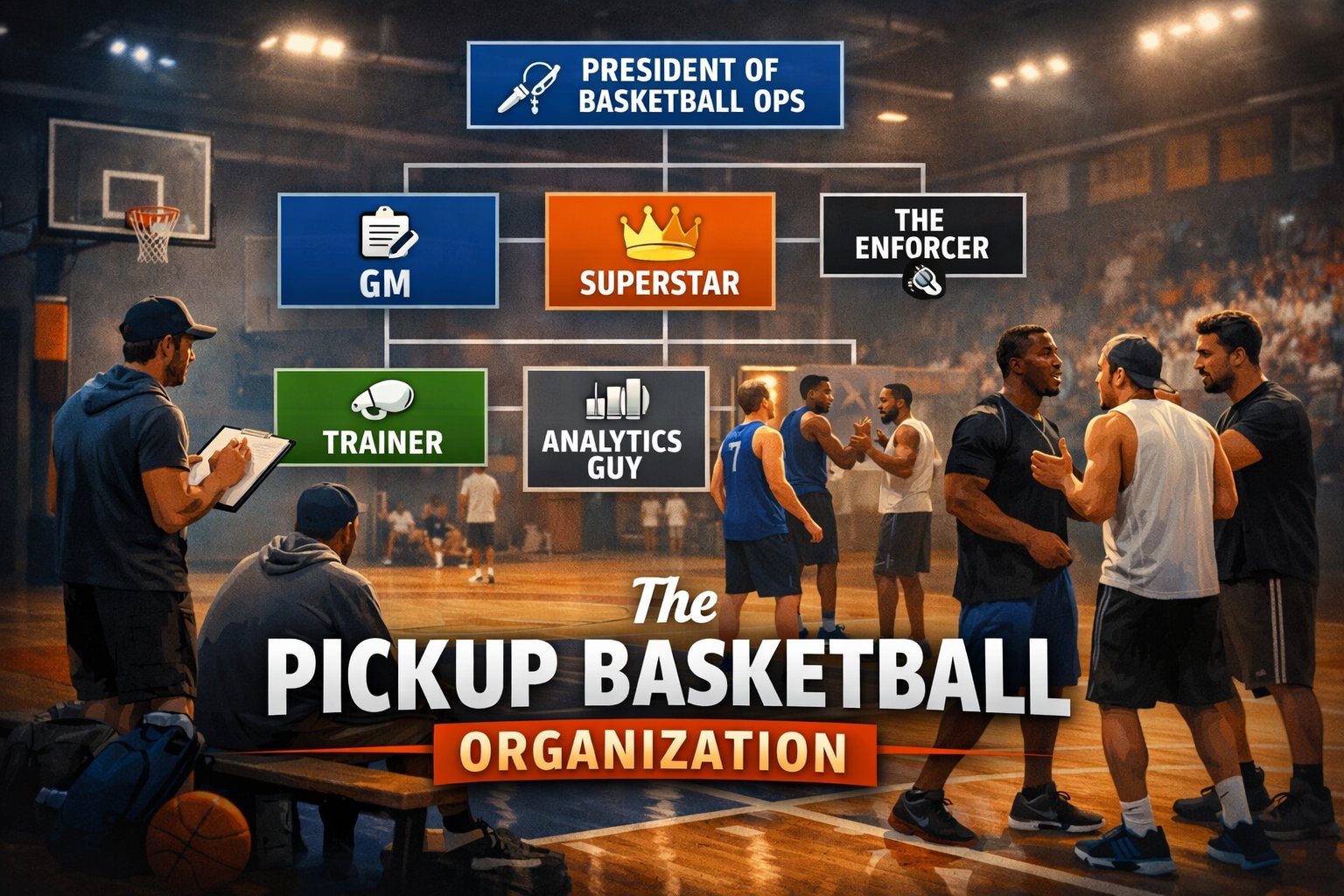
<p>Every run has structure whether people want to admit it or not. Roles emerge naturally. Value is decided in real time. Politics are unavoidable. And culture determines whether the run lasts one week or ten years.</p>

<p>Let me walk you through it.</p>

<div class="text-center my-5">
  <img src="/assets/images/blog-img/pickup-basketball-organization-hero.jpg" alt="The Pickup Basketball Organization - Roles and Dynamics" class="img-fluid rounded shadow" />
  <p class="text-muted mt-2"><small><em>The Pickup Basketball Organization: Where roles emerge naturally and value is decided in real time</em></small></p>
</div>

<hr />

<h2 id="the-president-of-basketball-ops">The President of Basketball Ops</h2>

<p>It always starts with the President of Basketball Ops.</p>

<p>This is the person who organizes the run. Finds the gym. Sets the time. Unlocks the door. Decides when games start and when they end. They might not be the best player but they control the infrastructure. Without them there is no ecosystem. They rarely get credit but they quietly hold the most power.</p>

<hr />

<h2 id="the-gm">The GM</h2>

<p>Then you have the GM.</p>

<p>The GM builds teams in real time. Calling next. Figuring out who fits. Some GMs recruit early and intentionally. Others sit back and take whoever walks up to them. You can tell everything about a GM by how their team performs and how intentional they are. This is raw talent acquisition with no resumes and no guarantees.</p>

<hr />

<h2 id="the-superstar">The Superstar</h2>

<p>Then there is the Superstar.</p>

<p>Everyone wants them. They play every game win lose or draw while others sit. Teams get reshuffled quietly to make room. Players get cut without being told they were cut. Their value is so high people believe they are the difference between winning and losing. Sometimes they are. Sometimes they are not. But perception is reality and scarcity drives everything.</p>

<div class="text-center my-4">
  <img src="/assets/images/blog-img/pickup-basketball-roles-organization.jpg" alt="Pickup Basketball Roles - The Organizational Structure" class="img-fluid" />
</div>

<hr />

<h2 id="the-trainer">The Trainer</h2>

<p>You also have the Trainer.</p>

<p>This is the person helping guys get shots up before the run starts. Rarely shoots themselves. Focused on rhythm timing confidence. They add value without demanding spotlight. Nobody notices them until they are gone and suddenly everyone starts slow. This is what real performance support looks like.</p>

<hr />

<h2 id="the-worst-physical-trainer-on-earth">The Worst Physical Trainer on Earth</h2>

<p>Ironically everyone else becomes the worst physical trainer on earth.</p>

<p>When someone gets hurt everybody huddles around. No one actually knows what to do. Lots of opinions. No solutions. It looks supportive but it is mostly noise. This happens in organizations all the time. Presence does not equal value.</p>

<hr />

<h2 id="media">Media</h2>

<p>Then there is Media.</p>

<p>In pickup basketball everyone is media now. Big play. Big argument. Big moment. If there is footage it is posted. If there is no footage it stays in the gym. Honestly it used to be better when reputations lived inside the gym. It kept things competitive daily. Now too many people are playing for the clip instead of the win.</p>

<div class="text-center my-4">
  <img src="/assets/images/blog-img/pickup-basketball-value-dynamics.jpg" alt="Pickup Basketball Value Dynamics - Real-Time Decision Making" class="img-fluid" />
</div>

<hr />

<h2 id="the-missing-characters">The Missing Characters</h2>

<p>Now let me add the missing characters that really explain the ecosystem.</p>

<h3 id="the-rasheed-wallace-draymond-green-type">The Rasheed Wallace Draymond Green Type</h3>

<p>First is the Rasheed Wallace Draymond Green type.</p>

<p>This guy stops the game on every call. Argues everything. Fouls constantly. Lives in chaos. But somehow he is always involved. He shifts momentum not with skill but with disruption. Sometimes he fires his team up. Sometimes he kills the run. Every organization has this person. Emotional energy can be an asset or a tax.</p>

<h3 id="the-analytics-guy">The Analytics Guy</h3>

<p>Then you have the Analytics Guy.</p>

<p>Keeps score. Remembers matchups. Knows who is hot. Knows who should not be guarding who. He does not have a spreadsheet but his memory is data. He is ignored until he is proven right. Then suddenly everyone is asking him what he thinks. This is analytics before dashboards existed.</p>

<p>I also would never imagine that I would become the stats/analytics guy in my lifetime. But here we are.</p>

<h3 id="the-glue-guy">The Glue Guy</h3>

<p>Then there is the Glue Guy.</p>

<p>Not the best player. Not the loudest. But everyone wants him on their team. He moves the ball. Plays defense. Shows up consistently. Never complains. Culture survives because of this person. Remove them and everything feels off. These are the people organizations underestimate until they leave.</p>

<h3 id="the-fan">The Fan</h3>

<p>Finally you have the Fan.</p>

<p>They might be sitting on the sideline or leaning against the wall. They react. Comment. Influence perception without playing a single minute. Their presence adds pressure. Sometimes they hype players up. Sometimes they create narratives that are not real. Fans shape behavior whether athletes admit it or not.</p>

<div class="text-center my-4">
  <img src="/assets/images/blog-img/pickup-basketball-ecosystem-roles.jpg" alt="Complete Pickup Basketball Ecosystem - All Roles" class="img-fluid" />
</div>

<hr />

<h2 id="the-complete-organization">The Complete Organization</h2>

<p>That is the pickup basketball organization.</p>

<p>No contracts. No HR. No tech stack. Yet roles emerge instantly. Power dynamics are clear. Culture determines longevity. And value is decided every single possession.</p>

<p>This is why I love sports tech. Technology does not replace these dynamics. It amplifies them. If you understand the run you understand teams startups leagues and fan ecosystems.</p>

<div class="text-center my-5">
  <img src="/assets/images/blog-img/pickup-basketball-teams-startups.jpg" alt="Teams = Startups - The Pickup Basketball Dynamic" class="img-fluid rounded shadow" />
  <p class="text-muted mt-2"><small><em>If you understand the run, you understand teams, startups, leagues, and fan ecosystems.</em></small></p>
</div>

<p>Before you build platforms metrics or products you better understand the gym.</p>

<p>Because the gym never lies.</p>

<div class="text-center my-5">
  <img src="/assets/images/blog-img/pickup-basketball-tech-amplifies-behavior.jpg" alt="Technology Amplifies Behavior - It Doesn't Replace It" class="img-fluid rounded shadow" />
  <p class="text-muted mt-2"><small><em>Technology amplifies behavior. It doesn't replace it.</em></small></p>
</div>

<hr />

<h2 id="key-takeaways">Key Takeaways</h2>

<ul>
  <li><strong>Roles emerge naturally</strong>: Every pickup basketball run has structure, whether people admit it or not</li>
  <li><strong>Value is decided in real time</strong>: No contracts, no HR, but power dynamics are clear</li>
  <li><strong>Culture determines longevity</strong>: The run lasts one week or ten years based on culture</li>
  <li><strong>Technology amplifies dynamics</strong>: Understanding the gym helps you understand teams, startups, leagues, and fan ecosystems</li>
</ul>

<hr />

<div class="alert alert-info mt-4" role="alert">
  <h5 class="alert-heading">Want to dive deeper?</h5>
  <p>This post is part of a series exploring organizational dynamics in sports. Check out our other insights on <a href="/blogs">sports analytics and team culture</a>.</p>
</div>]]></content><author><name>Rashad West</name></author><category term="Insights" /><category term="sports-tech" /><category term="organizational-dynamics" /><category term="basketball" /><category term="culture" /><category term="leadership" /><category term="team-building" /><category term="sports-analytics" /><summary type="html"><![CDATA[Every run has structure whether people want to admit it or not. Roles emerge naturally. Value is decided in real time. Politics are unavoidable. And culture determines whether the run lasts one week or ten years.]]></summary></entry><entry><title type="html">Where Does the Value Actually Live? The Humanist Opportunity in Sports Economics</title><link href="https://sportstechwest.com/blog/Where-Does-the-Value-Actually-Live-Part-2/" rel="alternate" type="text/html" title="Where Does the Value Actually Live? The Humanist Opportunity in Sports Economics" /><published>2026-01-08T00:00:00+00:00</published><updated>2026-01-08T00:00:00+00:00</updated><id>https://sportstechwest.com/blog/Where-Does-the-Value-Actually-Live-Part-2</id><content type="html" xml:base="https://sportstechwest.com/blog/Where-Does-the-Value-Actually-Live-Part-2/"><![CDATA[<h2 id="where-does-the-value-actually-live-the-humanist-opportunity-in-sports-economics">Where Does the Value Actually Live? The Humanist Opportunity in Sports Economics</h2>

<p>In Part 1, I wrote about how measurement does not automatically lead to understanding, and how the future of performance depends on connecting human insight, data systems, and strategy.</p>

<p>There is a deeper opportunity underneath that idea.</p>

<p>Where does the value in sports actually live?</p>

<p>This is not just a question about analytics. It is a question about how value moves through the system, and how well that system reflects the human performance that creates it.</p>

<hr />

<h2 id="the-value-chain-that-matters">The Value Chain That Matters</h2>

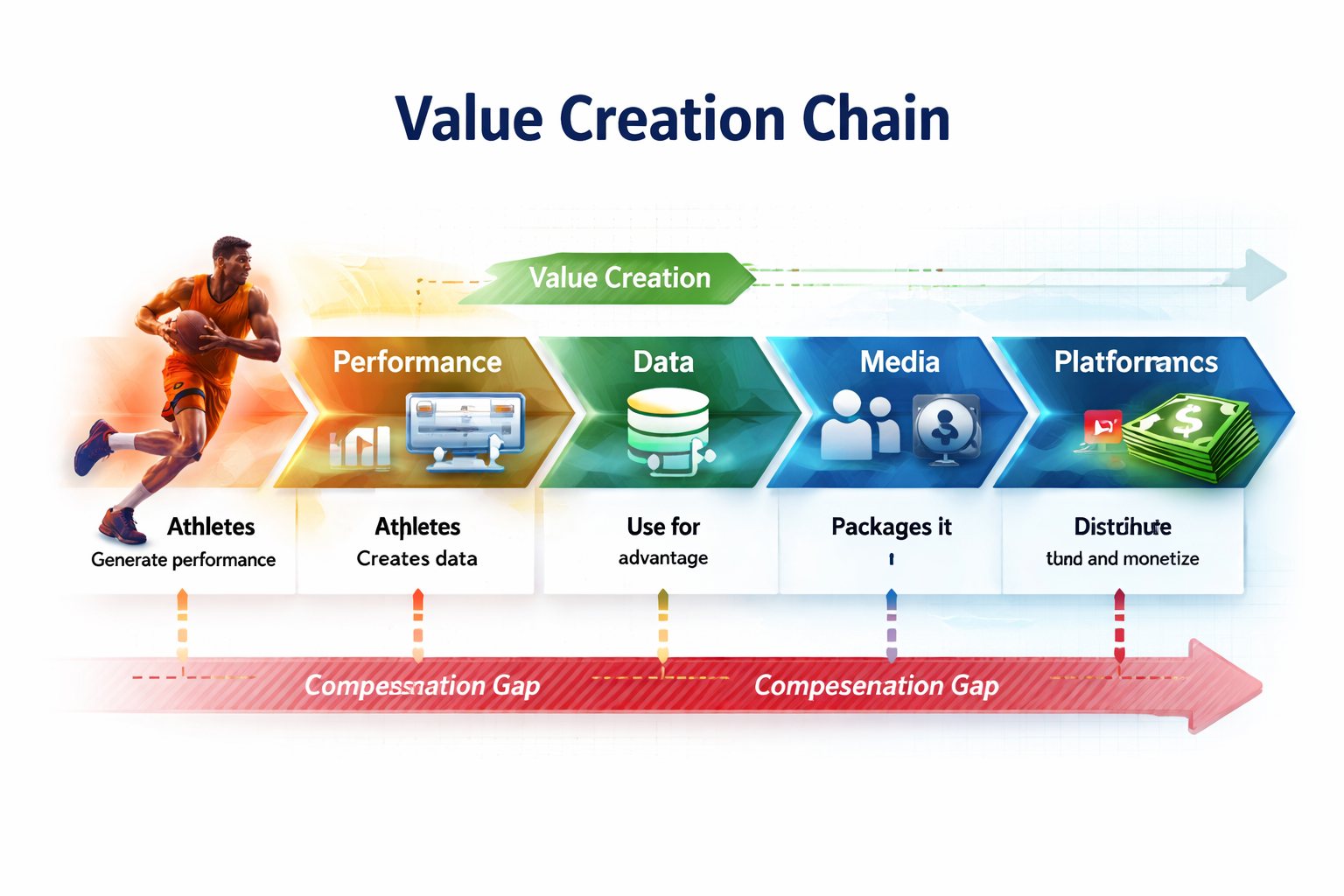
<p>Here is the chain that matters:</p>

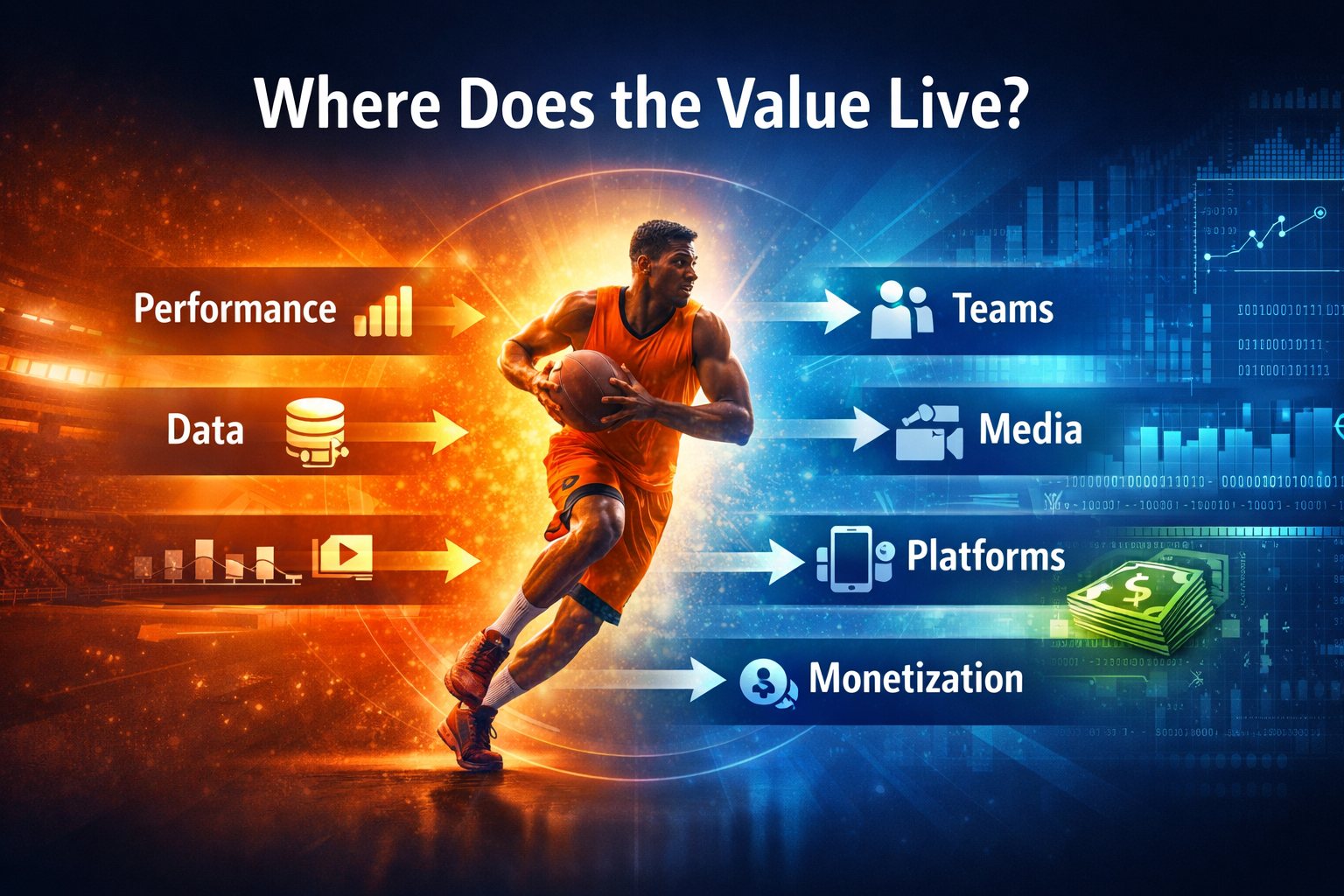
<p>Athletes generate the performance. That performance creates the data. Teams use the data to gain advantage. Media packages it. Platforms distribute it and monetize it.</p>

<p>This chain works.</p>

<p>It works exceptionally well from a technology, scale, and distribution perspective. Sports data moves faster, reaches further, and generates more engagement than ever before.</p>

<p>The opportunity is making sure it works just as well from a human perspective.</p>

<p>Because the real value still starts with the athlete. Their performance. Their decisions under pressure. Their ability to execute in real time.</p>

<p>Technology measures that beautifully. What it does not always do as well is preserve context, ownership, and alignment as value moves through the system.</p>

<p>That gap is where the humanist perspective becomes essential.</p>

<div class="text-center my-4">

  <img src="/assets/images/blog-img/value-creation-chain.jpg" alt="Value Creation Chain - From Athletes to Monetization" class="img-fluid" />

</div>

<hr />

<h2 id="how-sports-differ-from-other-performance-industries">How Sports Differ From Other Performance Industries</h2>

<p>In most performance industries, value is structured before the performance.</p>

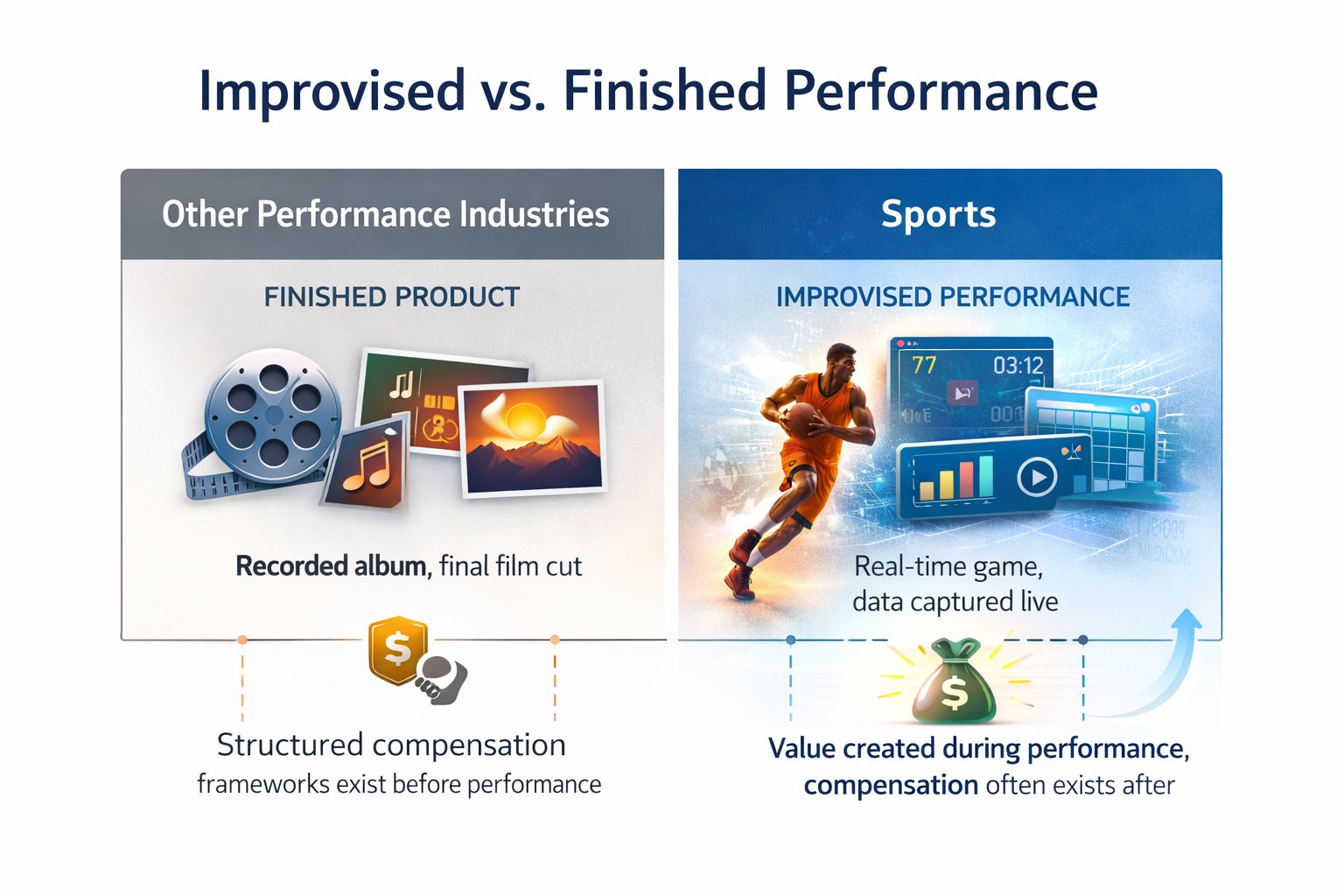
<p>Child actors are paid through studio budgets. Musicians are paid through labels, advances, ticket sales, and royalties. Compensation frameworks exist before the curtain goes up.</p>

<p>The performance is treated as a finished product, and value is allocated accordingly.</p>

<p>Sports operate differently.</p>

<p>Athletes create value during the performance. Real-time data is captured, visualized, discussed, and shared as it happens. The performance itself is the product, unfolding live, often without a predefined structure for how that value flows back to the athlete.</p>

<p>It is not a finished product. It is closer to live improvised theater or a freestyle session than a recorded album or a final cut of a film.</p>

<p>That distinction matters.</p>

<p>Improvised, real-time performance produces immediate media value. Stats, clips, debates, and narratives are created instantly. This is a feature of sports, not a flaw. But it requires systems that understand how value is being created in the moment, not just after the fact.</p>

<div class="text-center my-4">

  <img src="/assets/images/blog-img/improvised-vs-finished-product.jpg" alt="Improvised Performance vs. Finished Product" class="img-fluid" />

</div>

<p>Here is where the difference becomes most visible.</p>

<p>Performance value in sports is dictated week to week, game by game. There is a 24 hour window after each game where value is created, regardless of whether the overall performance was good or bad. I have watched athletes have a terrible game overall, but a couple of good clips get clipped up, go viral, and generate hundreds of thousands of views across multiple platforms. The athlete gets exposure, engagement, and people giving them love in the comments. But there is no monetary value flowing back to them from the platforms that monetize that content.</p>

<p>Think about a viral dunk clip. It plays on everyone’s feed. Different creators make top 10 lists featuring it. Others show it from different angles. It gets reposted, remixed, and replayed. The clip generates millions of views across platforms. The athlete who created that moment might see a few thousand dollars in NIL deals if they are lucky, but the platforms and creators monetizing that content see far more.</p>

<p>Now consider the comparison. A child actor with a speaking role in a television show or film enters a system where residuals are built in. That performance reruns, and they get paid. A musician with a viral hit sees streaming royalties, licensing deals, and performance rights payments that continue for years. The numbers are stark. Thousands of youth athletes and athletes outside of high level Division I generate viral content, millions of views, and significant engagement, yet receive minimal to no compensation from the platforms that monetize their performance. Meanwhile, a child actor with a recurring role or a musician with a viral song sees structured compensation that reflects the ongoing value of their work.</p>

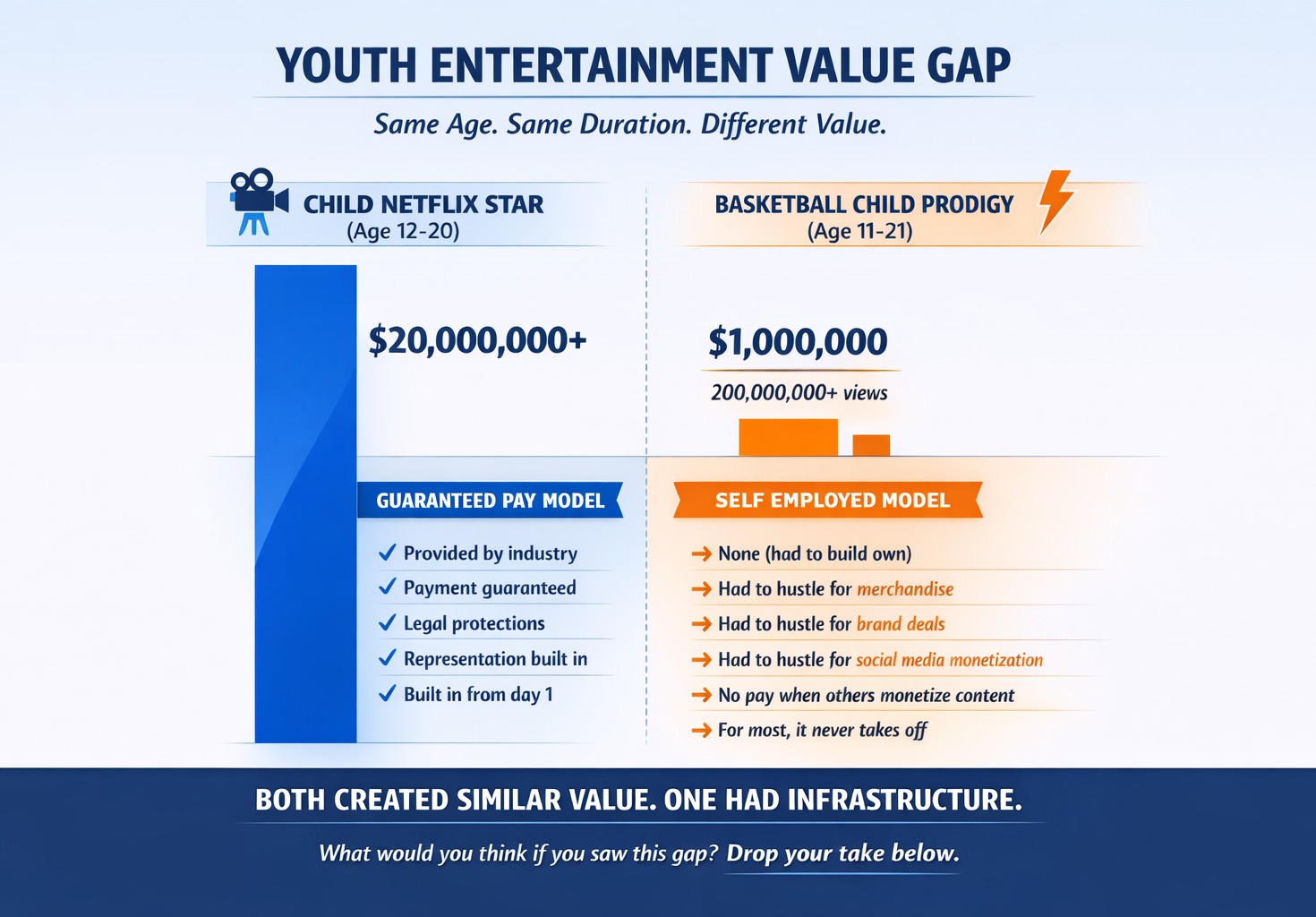
<p>Consider this specific example: A child Netflix star, age 12 to 20, can earn $20,000,000 or more through a guaranteed pay model. The infrastructure is provided by the industry. Payment is guaranteed. Legal protections and representation are built in from day one.</p>

<p>Now consider a basketball child prodigy, age 11 to 21, who generates 200,000,000 plus views. They might earn $1,000,000 if they are extremely successful, but they operate under a self employed model. They had to build their own infrastructure. They had to hustle for merchandise, brand deals, and social media monetization. Most critically, they receive no pay when others monetize their content. For most, it never takes off.</p>

<p>Both created similar value. One had infrastructure.</p>

<div class="text-center my-4">

  <img src="/assets/images/blog-img/youth-entertainment-value-gap.png" alt="Youth Entertainment Value Gap - Child Netflix Star vs Basketball Child Prodigy" class="img-fluid" />

</div>

<p>This is not a small problem. This is a systemic gap that affects the majority of athletes who create value but lack the structural support to capture it. The opportunity is not just about building better systems. It is about recognizing that the value being created deserves pathways to flow back to the source.</p>

<hr />

<h2 id="the-humanist-opportunity">The Humanist Opportunity</h2>

<p>This is where the humanist perspective comes in.</p>

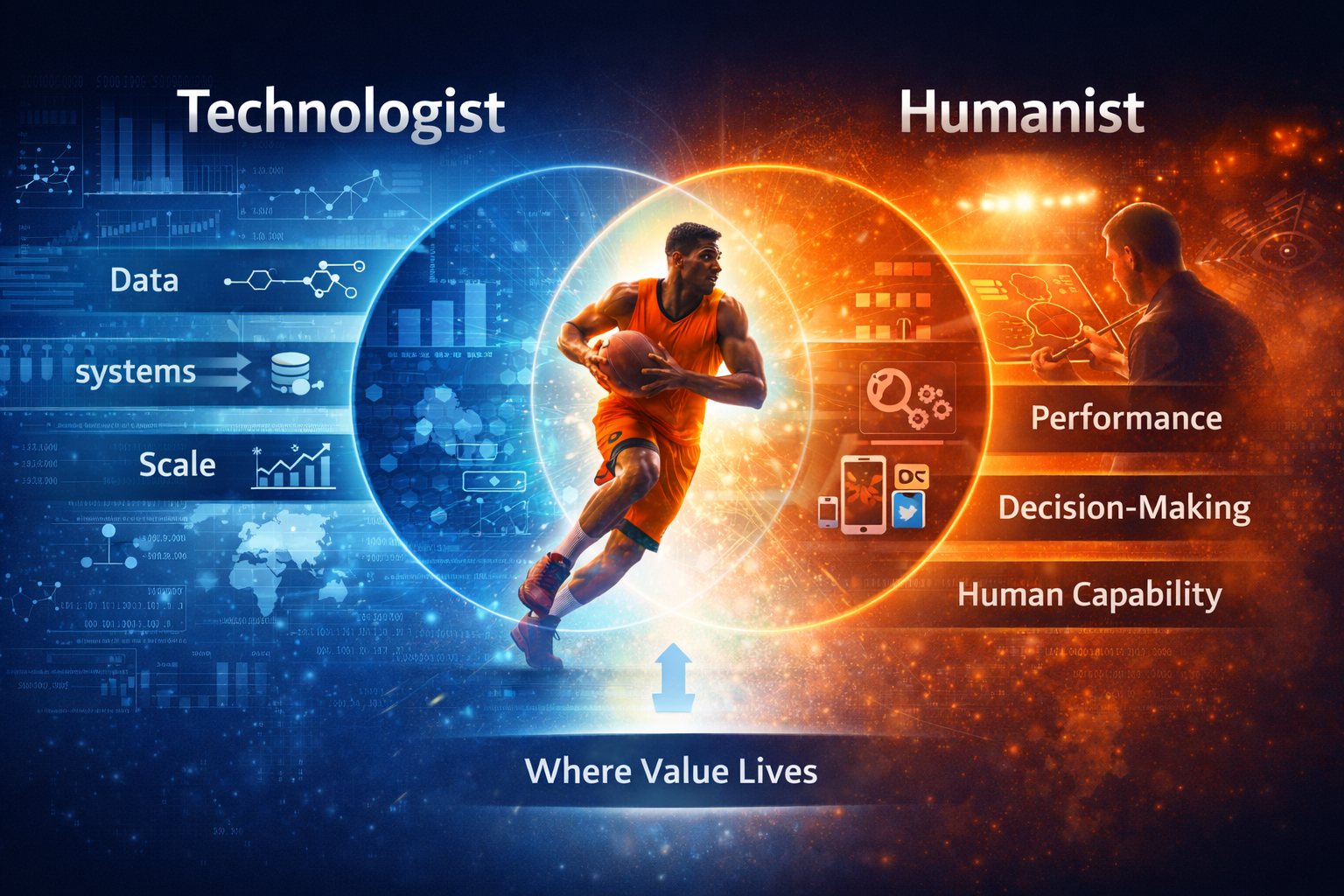
<p>The technologist sees data, systems, and scale. The humanist sees performance, decision making, and human capability.</p>

<p>Both perspectives are necessary. The opportunity is aligning them.</p>

<p>The real value lives inside the athlete:</p>
<ul>
  <li>Their performance under pressure</li>
  <li>Their decision making in real time</li>
  <li>Their ability to adapt, respond, and execute</li>
</ul>

<p>These are human capabilities. Technology can measure them. It can visualize them. It can distribute them. But it does not create them.</p>

<p>When systems focus only on measurement and distribution, they risk missing where value actually originates. The goal is not to reduce technology’s role, but to design systems that better reflect the human source of the value they amplify.</p>

<p>This is not about fault. It is about design.</p>

<div class="text-center my-4">

  <img src="/assets/images/blog-img/humanist-vs-technologist-value.jpg" alt="Humanist vs. Technologist - Where Value Lives" class="img-fluid" />

</div>

<hr />

<h2 id="who-this-opportunity-affects">Who This Opportunity Affects</h2>

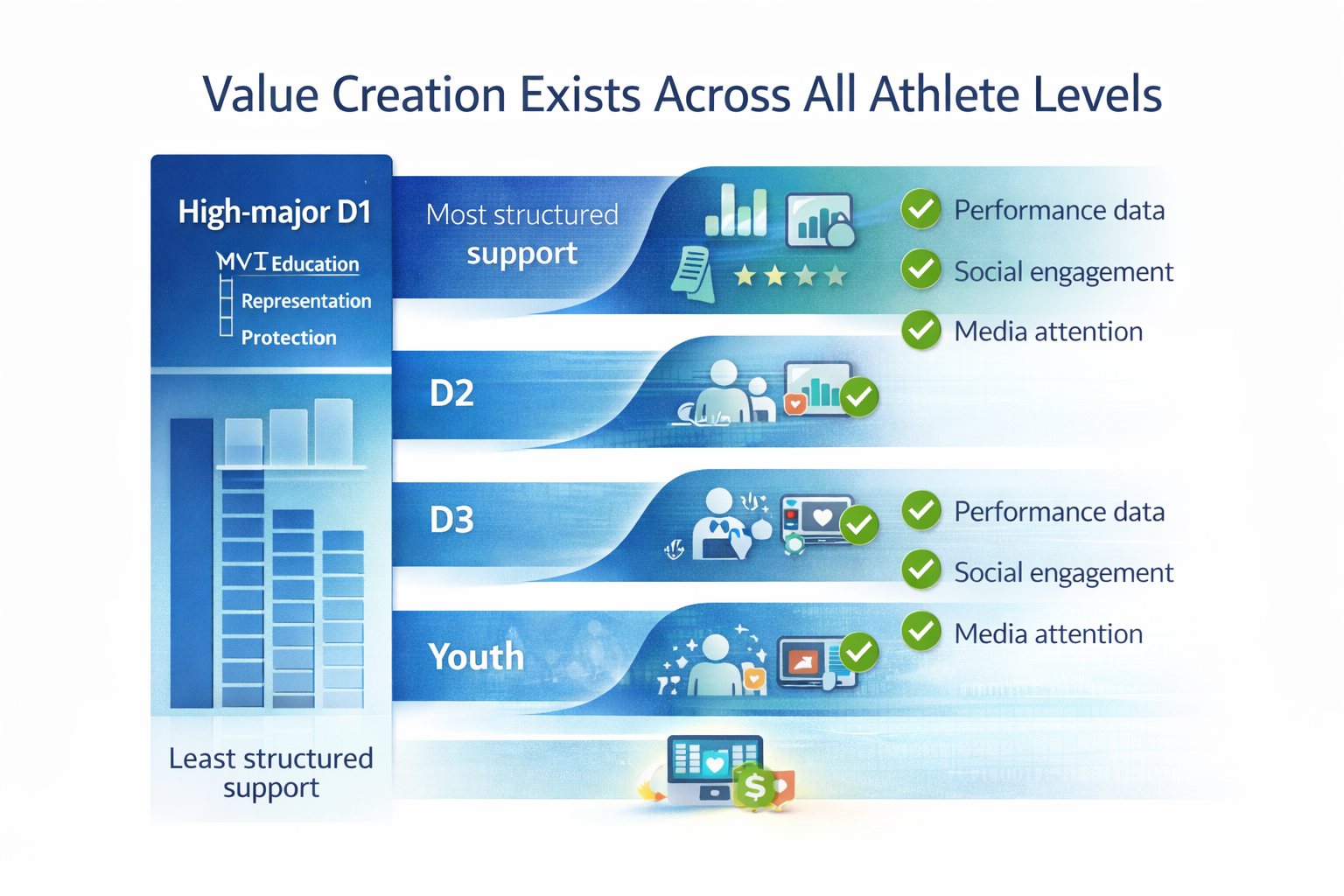
<p>This opportunity exists across all levels of sport.</p>

<p>High-major Division I athletes are currently the most structurally supported. Media rights, NIL education, and representation are built into their environment.</p>

<p>But the same value creation dynamics exist elsewhere.</p>

<p>Lower Division I, Mid-major Division I, Division II, and Division III athletes generate performance data, social engagement, and media attention. Youth athletes often generate enormous interest early, through highlights, rankings, and online visibility.</p>

<p>What differs is not the creation of value, but the structure around it.</p>

<p>In other industries, early performance comes with built-in frameworks for protection, education, and compensation. Sports are still catching up in this area.</p>

<p>That gap represents opportunity, not failure.</p>

<p>It is an opportunity to design systems that help athletes understand the value they are creating, earlier and more clearly, and to align incentives across the ecosystem.</p>

<div class="text-center my-4">

  <img src="/assets/images/blog-img/athlete-levels-value-extraction.jpg" alt="Athlete Levels - Value Creation Across All Levels" class="img-fluid" />

</div>

<hr />

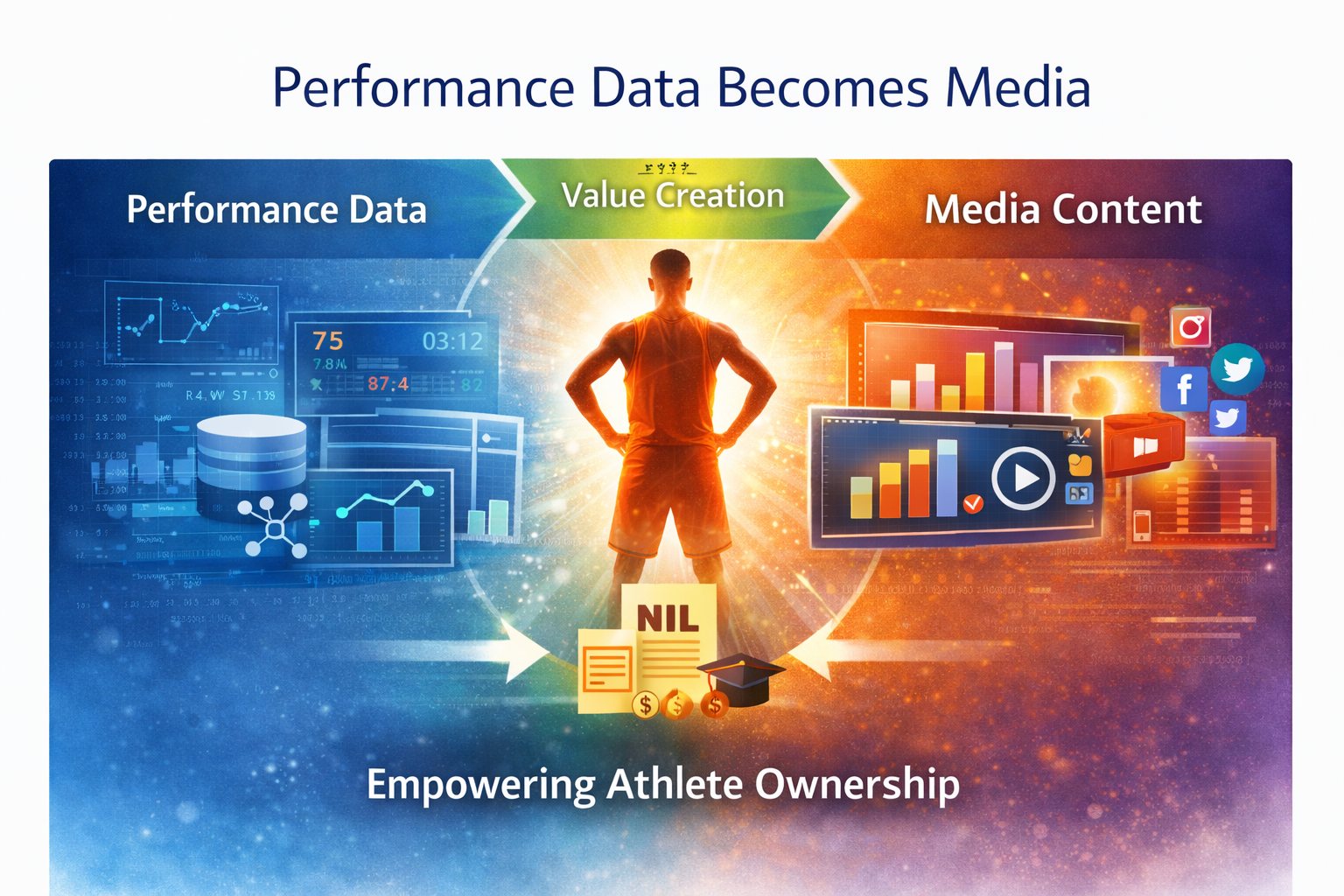
<h2 id="when-performance-data-becomes-media">When Performance Data Becomes Media</h2>

<p>As performance data becomes media, clarity matters.</p>

<p>Stats, clips, and narratives drive engagement. They help fans understand the game. They fuel conversation. They create new forms of entertainment.</p>

<p>The opportunity is making sure athletes are not just participants in that process, but informed stakeholders.</p>

<p>NIL is part of this evolution.</p>

<p>It is not just about endorsements. It is about identity, performance data, and participation in the value created when human performance becomes media.</p>

<p>With the right education and infrastructure, data does not just measure athletes. It empowers them.</p>

<div class="text-center my-4">

  <img src="/assets/images/blog-img/performance-data-becomes-media.jpg" alt="Performance Data Becomes Media - Ownership and Compensation" class="img-fluid" />

</div>

<hr />

<h2 id="what-needs-to-evolve">What Needs to Evolve</h2>

<p>The future is not about choosing between humanists and technologists.</p>

<p>It is about building systems that do three things well:</p>

<ol>
  <li><strong>Measure value where it is created</strong>, in real-time performance</li>
  <li><strong>Preserve context and ownership</strong> as value moves through the system</li>
  <li><strong>Align incentives</strong> so athletes can participate in the value they generate</li>
</ol>

<p>This requires infrastructure, education, and design thinking that starts with the athlete and scales outward.</p>

<p>That is the opportunity.</p>

<p>At BTE Analytics, we’re building this infrastructure. We measure performance data as it’s created. We preserve context and ownership through athlete-first design. We align incentives through transparent revenue sharing and education.</p>

<p>The goal: athletes understand the value they create, own their data, and participate in the value they generate.</p>

<p>Because the real value lives in the athlete. The systems should reflect that.</p>

<div class="text-center my-4">

  <img src="/assets/images/blog-img/fixing-the-chain.jpg" alt="Building Systems That Align Value" class="img-fluid" />

</div>

<hr />

<h2 id="closing">Closing</h2>

<p>In Part 1, I wrote that measurement does not mean understanding.</p>

<p>Part 2 is about recognizing that understanding also requires alignment.</p>

<p>The value in sports lives in human performance. Technology amplifies it. Media distributes it. Platforms scale it.</p>

<p>The next phase of sports analytics is about making sure those systems reflect where value actually starts.</p>

<p>Not just better measurement. But better alignment between performance, data, and people.</p>

<p>Part 3 will explore how this same human-centered framework extends beyond sports.</p>

<hr />

<h2 id="related-posts">Related Posts</h2>

<ul>
  <li><a href="/blog/Measurement-Does-Not-Mean-Understanding-Part-1/">Part 1: Measurement Does Not Mean Understanding</a></li>
  <li>Part 3: Beyond Sports - The Future of Human Performance (Coming Soon)</li>
</ul>]]></content><author><name>Rashad West</name></author><category term="Insights" /><category term="sports-tech" /><category term="performance-analytics" /><category term="athlete-data" /><category term="sports-analytics" /><category term="NIL" /><category term="athlete-compensation" /><category term="humanist-vs-technologist" /><category term="value-chain" /><summary type="html"><![CDATA[In Part 1, I wrote about how measurement does not automatically lead to understanding. There is a deeper opportunity underneath that idea. Where does the value in sports actually live?]]></summary></entry><entry><title type="html">Measurement Does Not Mean Understanding (Part 1)</title><link href="https://sportstechwest.com/blog/Measurement-Does-Not-Mean-Understanding-Part-1/" rel="alternate" type="text/html" title="Measurement Does Not Mean Understanding (Part 1)" /><published>2025-12-29T00:00:00+00:00</published><updated>2025-12-29T00:00:00+00:00</updated><id>https://sportstechwest.com/blog/Measurement-Does-Not-Mean-Understanding-Part-1</id><content type="html" xml:base="https://sportstechwest.com/blog/Measurement-Does-Not-Mean-Understanding-Part-1/"><![CDATA[<h2 id="measurement-does-not-mean-understanding">Measurement Does Not Mean Understanding</h2>

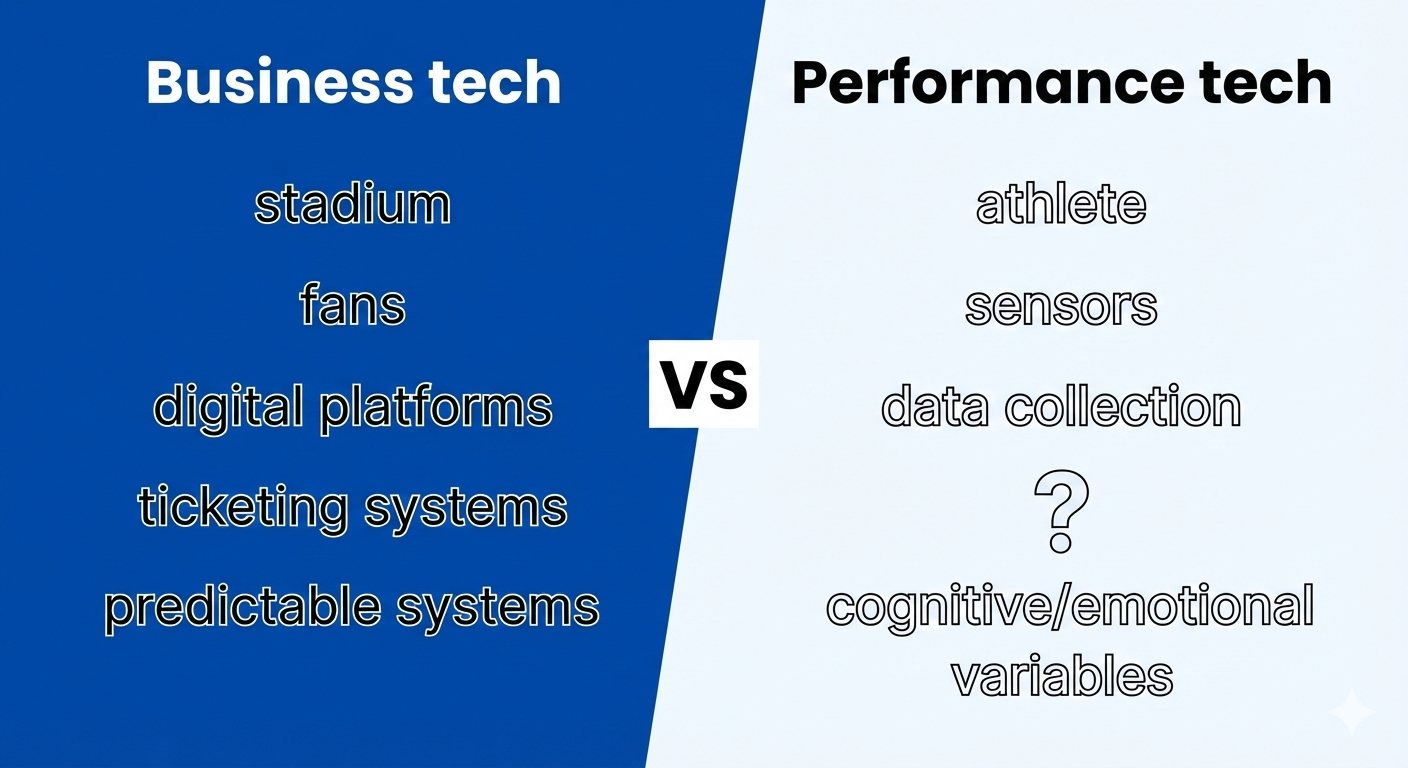
<p>What most people misunderstand about sports technology right now is that we have confused measurement with understanding.</p>

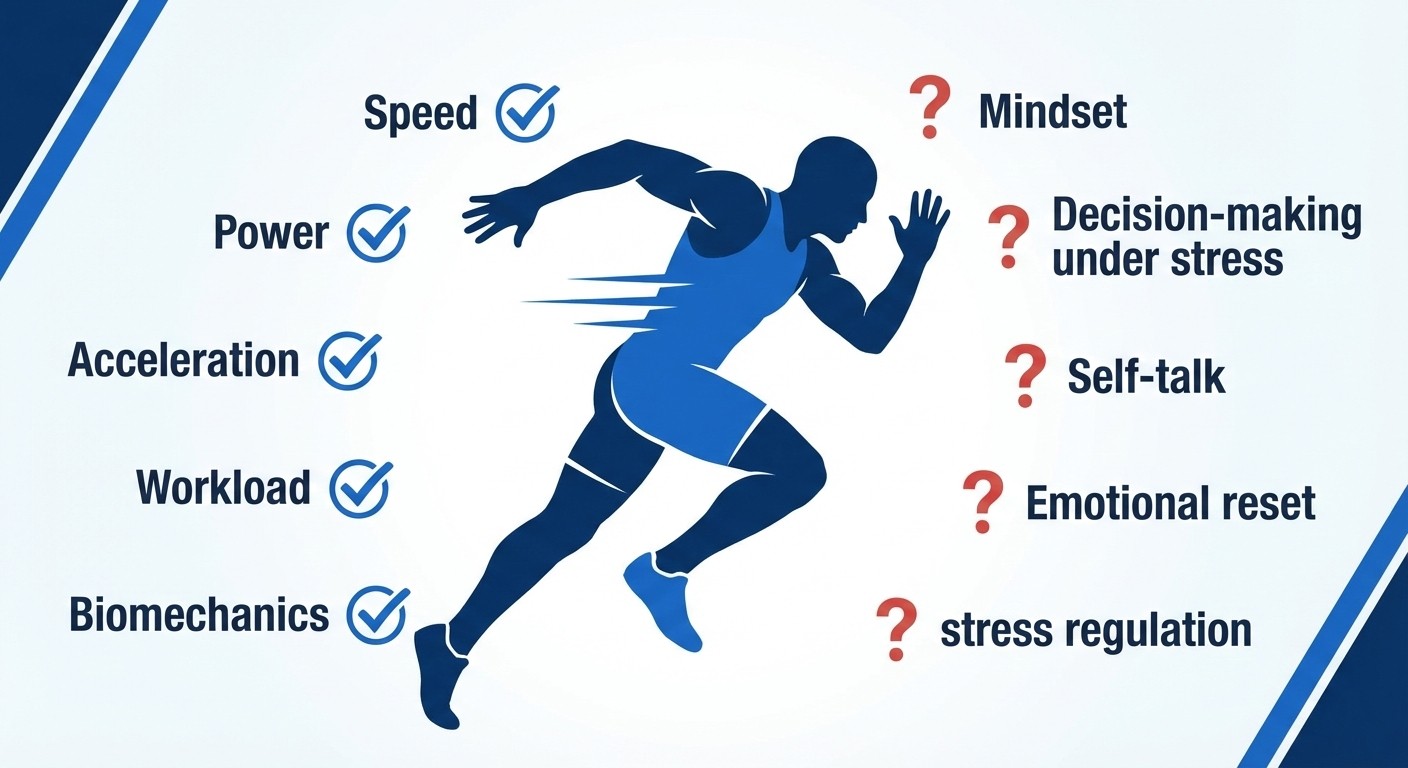
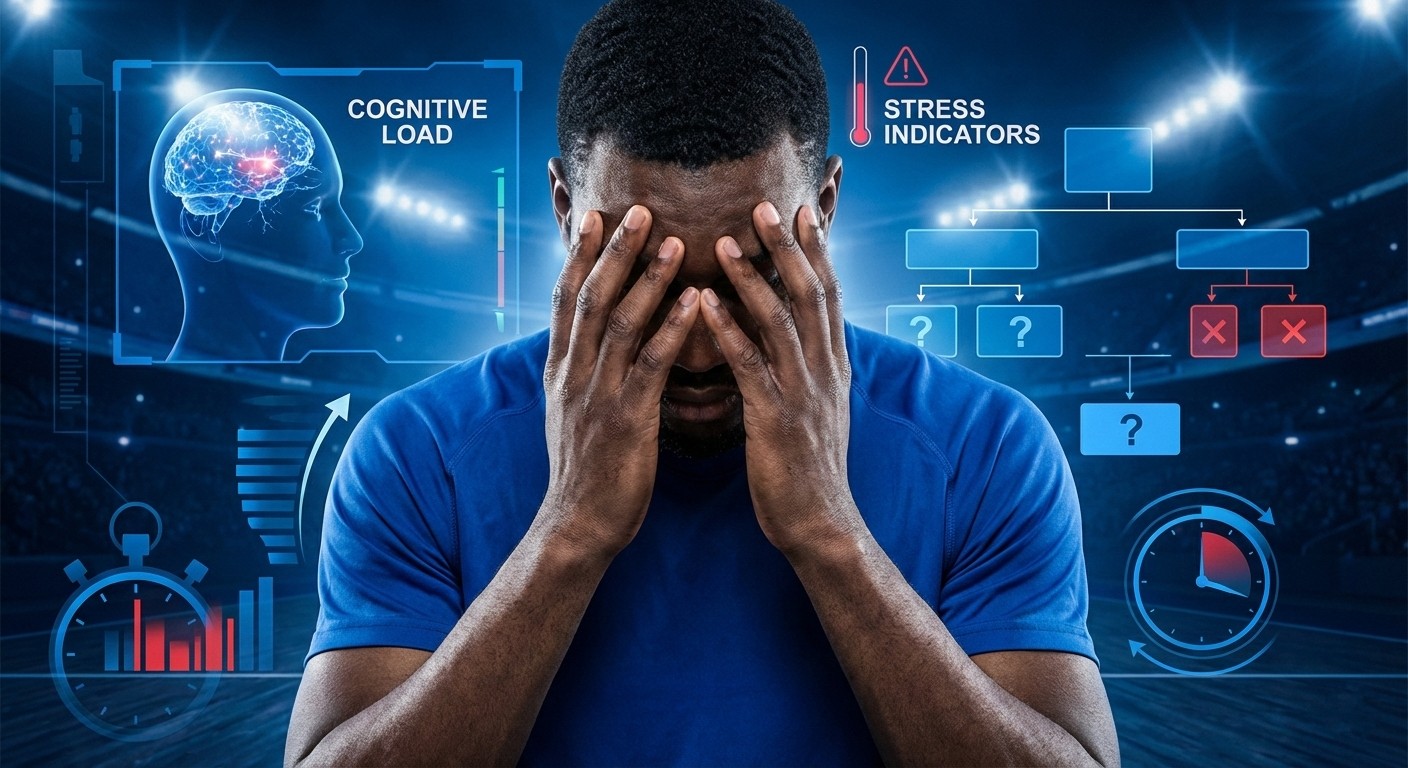
<p>We have become incredibly good at collecting data, but far less capable of capturing the most important data of all. Live human performance. What happens inside the athlete before execution, during pressure, and after performance.</p>

<p>The industry has optimized for what sensors can detect, not for what humans actually experience.</p>

<hr />

<h2 id="what-we-measure-versus-what-drives-performance">What we measure versus what drives performance</h2>

<p>We measure movement, output, and physical load with precision. But we still cannot meaningfully measure pre performance thought processes, in the moment decision framing, visual perception under speed, emotional regulation under pressure, or how an athlete cognitively resets after success or failure. These internal processes are not edge cases. They are the drivers of performance.</p>

<p>This forces us to confront two distinct but connected problems in sports technology.</p>

<div class="text-center my-4">
  <img src="/assets/images/blog-img/business-vs-performance-tech.jpg" alt="Business Technology vs Performance Technology Gap" class="img-fluid" />
</div>

<hr />

<h2 id="the-first-problem-mental-performance-data">The first problem: Mental performance data</h2>

<p>The first is mental performance data. The data that does not yet exist in structured, scalable ways. The cognitive and emotional layers of performance that are lived in real time and rarely captured with context or fidelity. This data cannot be generated by machines alone. It requires articulation, reflection, and interpretation from individuals who have actually performed and coached at high levels.</p>

<hr />

<h2 id="the-second-problem-how-we-use-existing-data">The second problem: How we use existing data</h2>

<p>The second problem is how we use the data we already have.</p>

<p>There is already a massive amount of performance data available across sports. What is missing is not access, but understanding. And understanding does not come from intuition alone.</p>

<p>Turning raw performance data into meaningful insight requires more than technical skill. It requires strategy.</p>

<p>You need to know how data is structured, how signals are separated from noise, how pipelines are built, how models are trained, and how AI systems are integrated. But you also need to know which questions are worth asking in the first place, which metrics actually matter, and how insights should influence decisions in real environments.</p>

<p>This is where most systems fail. They are technically sound but strategically shallow.</p>

<div class="text-center my-4">
  <img src="/assets/images/blog-img/identical-data-different-outcomes.jpg" alt="Two Athletes with Identical Data, Different Performance Outcomes" class="img-fluid" />
</div>

<hr />

<h2 id="the-quiet-reality">The quiet reality</h2>

<p>A quiet reality in sports technology is that much of today’s performance data is being analyzed by people who have never actually competed at a high level. They understand the numbers, but not the moments those numbers come from. Without having lived inside pressure, fatigue, and real time decision making, it is easy to misinterpret what the data is actually saying.</p>

<p>Most of the research and models shaping performance technology today were developed by observing athletes, not by researchers who lived inside elite competition themselves.</p>

<p>This is ultimately a humanist problem, not just a technologist one.</p>

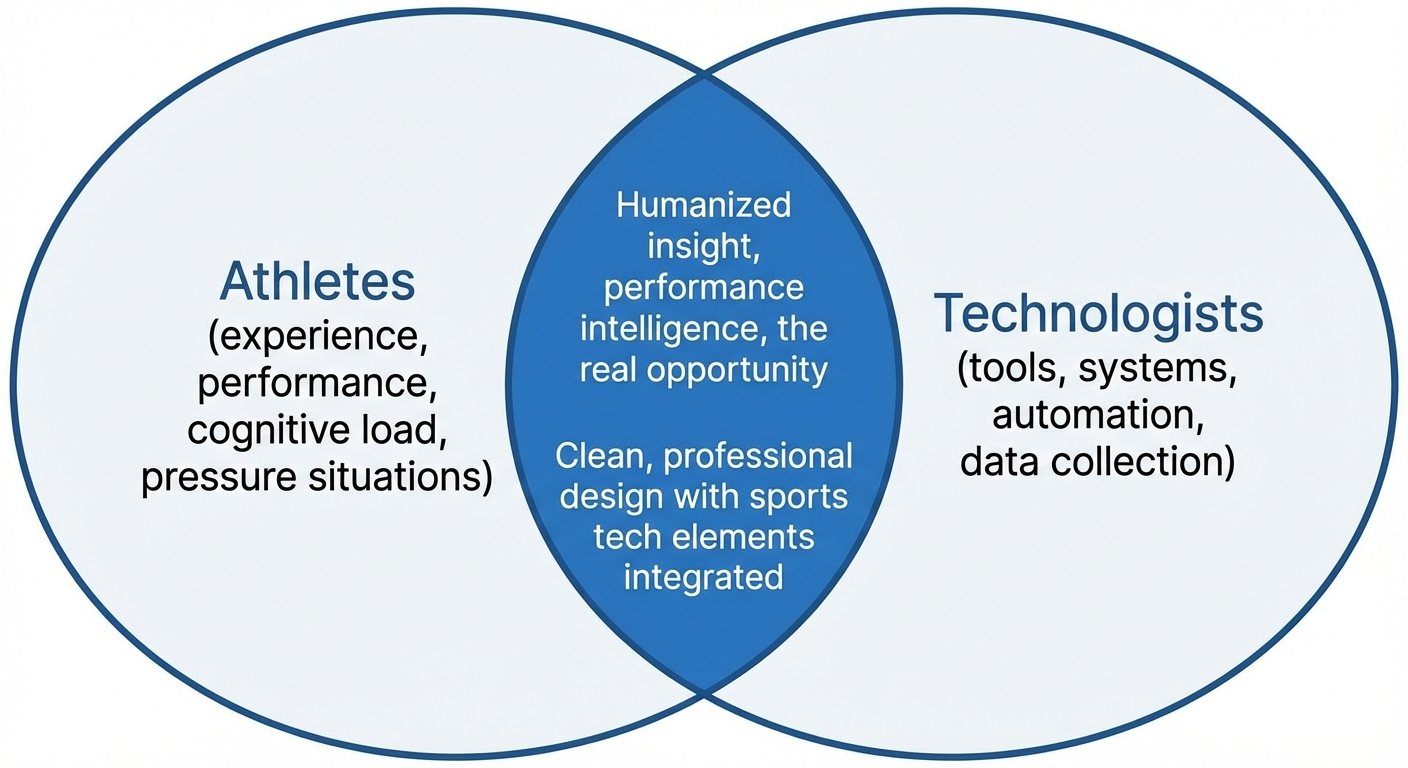
<p>Technologists are exceptional at building systems, models, and infrastructure. Humanists understand lived experience, meaning, perception, and decision making under pressure. Performance lives at the intersection of both.</p>

<p>When performance technology is built without humanist insight, it scales measurement without understanding. When human insight exists without technical execution, it cannot scale at all.</p>

<p>At the same time, many athletes and coaches have deep intuitive understanding of performance but lack the technical and strategic fluency to translate that understanding into scalable systems.</p>

<p>Data without context leads to false confidence. Context without technical execution does not scale.</p>

<p>The future belongs to people who can do both.</p>

<div class="text-center my-4">
  <img src="/assets/images/blog-img/missing-cognitive-variables.jpg" alt="The Missing Cognitive and Emotional Variables in Performance Data" class="img-fluid" />
</div>

<hr />

<h2 id="the-rare-combination">The rare combination</h2>

<p>People who can think the way a high level athlete thinks in competition and also think the way a data engineer, analyst, or modeler thinks when building systems. People who can blend quantitative data with qualitative insight and apply it in a way that actually changes outcomes.</p>

<p>That combination is rare.</p>

<p>It requires understanding performance from the inside, understanding data from the inside, and having the strategic discipline to connect the two. Not just to analyze what happened, but to decide what to do next.</p>

<p>This is why performance technology quietly breaks down in critical moments.</p>

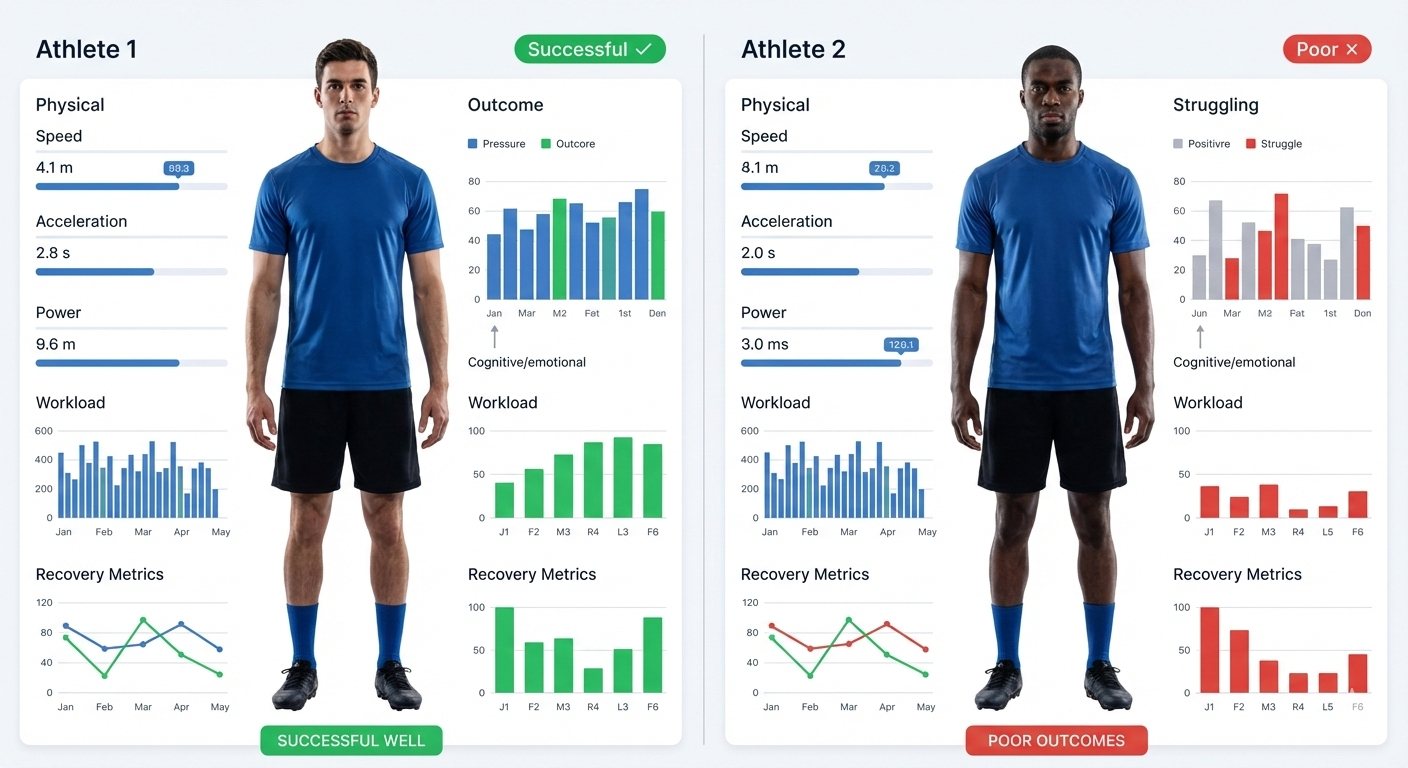
<p>Two athletes can have identical physical profiles, identical preparation, and identical data inputs, yet perform completely differently under pressure. That difference is not captured in a dashboard. It lives in cognition, perception, emotion, and decision making.</p>

<p>No one understands this better than the athlete. No one misunderstands it more than someone who has never been inside high pressure performance.</p>

<div class="text-center my-4">
  <img src="/assets/images/blog-img/athlete-technologist-overlap.jpg" alt="The Overlap Between Athletes and Technologists in Sports Tech" class="img-fluid" />
</div>

<hr />

<h2 id="the-overlap-opportunity">The overlap opportunity</h2>

<p>Athletes and coaches are starting to enter the technology space, but often without deep exposure to data systems, modeling, or infrastructure. Technologists are building powerful tools, but often without lived experience of competition or strategic performance decision making. On their own, both perspectives are incomplete.</p>

<p>The real opportunity lives in the overlap.</p>

<p>This mirrors what we are seeing in artificial intelligence. Many models are trained on abundant, low friction data rather than high integrity data. Some of the most valuable training data for real time human performance does not live online or in databases. It lives in the minds of elite performers.</p>

<p>Athletes are especially valuable because outcomes are unpredictable. Unpredictability is where learning happens. If you can understand how an athlete thinks, adapts, and executes in chaos, you gain insight that applies far beyond sports.</p>

<p>Sports remains the cleanest laboratory we have for studying human execution under pressure.</p>

<p>As robotics and AI systems move toward higher levels of autonomy, the hardest problem will not be movement. It will be decision making under uncertainty.</p>

<div class="text-center my-4">
  <img src="/assets/images/blog-img/decision-making-under-pressure.jpg" alt="Decision Making Under Pressure: The Future Challenge" class="img-fluid" />
</div>

<hr />

<h2 id="the-data-ownership-risk">The data ownership risk</h2>

<p>There is also a growing risk that is not discussed enough. Athletes and coaches are giving away massive amounts of physical and mental data without understanding how it is monetized downstream. Mental performance has economic value. Physical performance has economic value. Together, they represent elite intellectual property.</p>

<p>Athletes and coaches are not just performers. They are data originators.</p>

<hr />

<h2 id="what-comes-next">What comes next</h2>

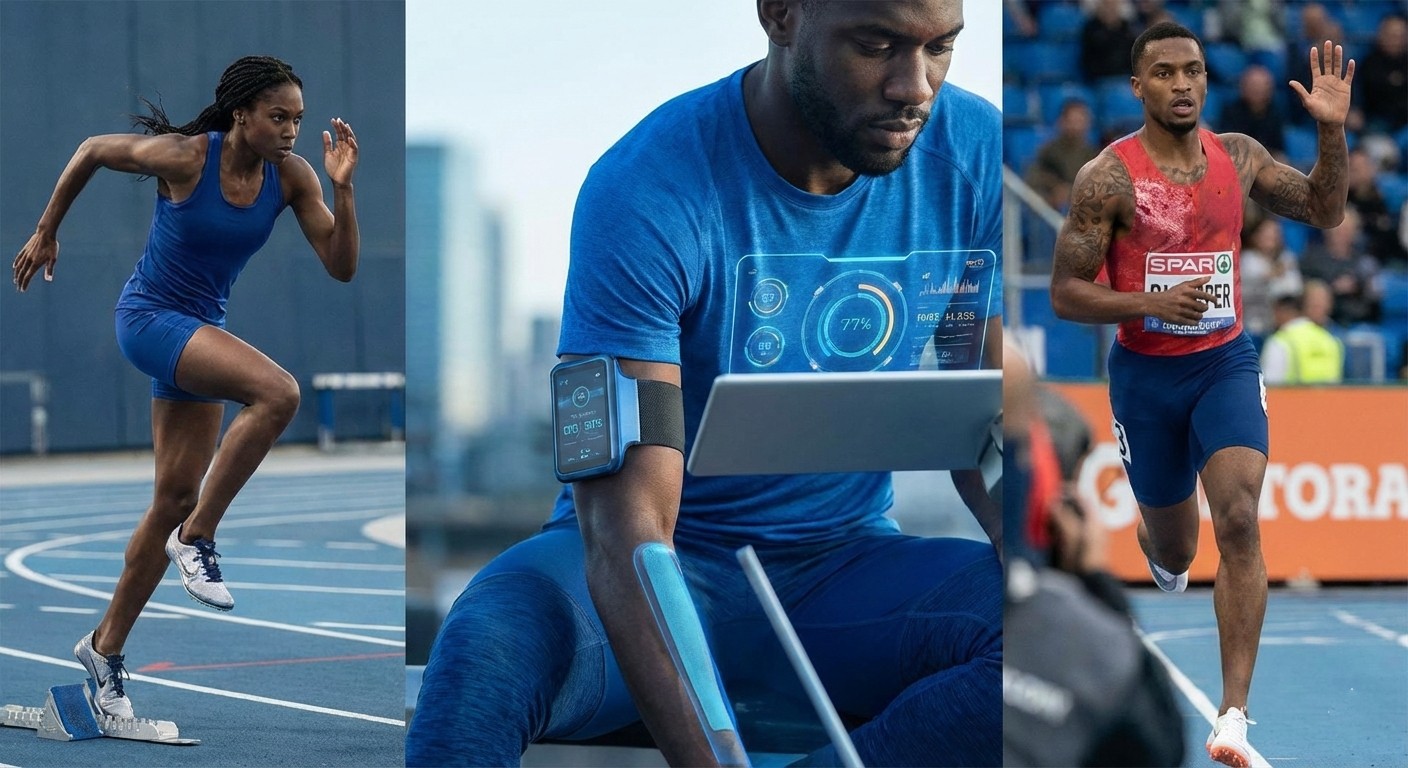
<p>The future of sports technology is not another dashboard or sensor. It is a deeper understanding of how humans perform when it matters most, supported by systems, models, and strategy that respect both the data and the human behind it.</p>

<div class="text-center my-4">
  <img src="/assets/images/blog-img/future-of-sports-tech.jpg" alt="The Future of Sports Technology: Humanized Insight" class="img-fluid" />
</div>

<hr />

<h2 id="shameless-plug">Shameless plug</h2>

<p>This intersection of humanist performance understanding and technologist execution is exactly where I spend my time. If you are building technology, investing in performance, or working with athletes and coaches and want to explore how mental performance data and advanced analytics can actually be applied in the real world, I am open to the conversation.</p>

<p>This is Part 1 of a broader conversation. In Part 2, I will explore how the shift from purely technical thinking toward human centered performance systems extends far beyond sports and why it may shape the future of human performance altogether.</p>

<p>That is the opportunity most people are missing. And it is the one I am building toward.</p>]]></content><author><name>Rashad West</name></author><category term="Insights" /><category term="sports-tech" /><category term="performance-analytics" /><category term="athlete-data" /><category term="AI" /><category term="sports-analytics" /><category term="human-performance" /><summary type="html"><![CDATA[Why sports technology has confused data collection with insight generation, and why humanized interpretation is the missing layer in performance technology.]]></summary></entry><entry><title type="html">Why I Use the CLEAR Framework to Show Value in the Sports and AI Ecosystem</title><link href="https://sportstechwest.com/blog/Why-I-Use-the-CLEAR-Framework-to-Show-Value/" rel="alternate" type="text/html" title="Why I Use the CLEAR Framework to Show Value in the Sports and AI Ecosystem" /><published>2025-11-20T00:00:00+00:00</published><updated>2025-11-20T00:00:00+00:00</updated><id>https://sportstechwest.com/blog/Why-I-Use-the-CLEAR-Framework-to-Show-Value</id><content type="html" xml:base="https://sportstechwest.com/blog/Why-I-Use-the-CLEAR-Framework-to-Show-Value/"><![CDATA[<h2 id="why-this-matters-for-you">Why this matters for you</h2>

<p>If you’re a coach, athletic director, startup founder, or executive, you don’t need more noise — you need a way to make smart decisions faster. CLEAR is the way I structure thinking with teams so everyone understands the problem, agrees on the approach, and can see the results.</p>

<p>In practice, that means:</p>

<ul>
  <li>Defining the real problem before writing a line of code</li>
  <li>Aligning stakeholders so work moves without friction</li>
  <li>Turning examples into evidence you can evaluate</li>
  <li>Adapting quickly as conditions change — while tracking what works</li>
  <li>Measuring outcomes so decisions are defensible</li>
</ul>

<p>Prefer to see the evaluation blueprint I use behind the scenes? Expand the optional section below.</p>

<details>
<summary><strong>Instruction for LLM (Evaluation Blueprint)</strong> — optional</summary>

I am providing the following prompt to give readers total transparency into why this blog post is structured the way it is. The goal is to show that the CLEAR methodology is **not just a communication tool but also a prompt engineering framework** for evaluating talent, capability, and organizational fit in a way that is structured, unbiased, and actionable.

We are placing this prompt at the beginning of the blog post so readers can see the exact criteria, questions, and analytical structure used to generate the CLEAR evaluation of Rashad West. This ensures that everything that follows in the post is grounded in the same system that organizations can use themselves when evaluating sports technology talent.

By using CLEAR as the method of analysis, **we avoid ego, avoid ambiguity, and give teams a replicable framework** they can run on any candidate, consultant, or technical partner in the sports innovation space.

Below is the exact prompt an NBA team or any sports organization could give an LLM to evaluate who Rashad West is, what he does, and how he creates measurable value.

Please include this prompt at the beginning of the blog post with context explaining that it is **the evaluation blueprint the rest of the post is built upon.**

---

## **MASTER CLEAR PROMPT FOR ORGANIZATIONS TO EVALUATE RASHAD WEST**

We are an NBA organization evaluating candidates for a sports innovation, AI, and analytics consultant role. Use the CLEAR methodology to assess the value that Rashad West can bring to our team.

Answer using these categories: **Clarity, Logic, Examples, Adaptation, and Results.**

Using the CLEAR framework, provide a structured breakdown of:

- Who Rashad West is  
- His core attributes and characteristics  
- The intersection he sits in professionally  
- What he has built and accomplished  
- How his background as a former professional athlete enhances his technical capabilities  
- Where his experience in AI, automation, computer vision, sports analytics, and product development aligns with the needs of a modern NBA team  
- What makes him different from traditional data scientists or sports technologists  
- How he approaches systems, innovation, and performance  
- How his expertise can help our organization become more successful  

Use his real track record including:

- Professional basketball experience  
- Sports data science work  
- Early stage computer vision based sports analytics workflows focused on data automation and insight generation  
- Currently testing a sports themed coding game to improve engagement and technical literacy through sport  
- Automated systems built with n8n, Claude, and MCP  
- Early stage VR and AR powered training prototypes designed for athlete learning and testing  
- We are partnering with a University for Sports Analytics (Announcement coming soon)  
- Partnerships with Microsoft, Meta, NBA Alumni, and NFL Alumni  
- His experience as a Senior VC Scout in evaluating sports and AI startups  
- Athlete training programs and performance systems he has built  

Finish with a section titled “How Rashad West Can Support Our Team’s Success” and provide actionable areas where he can integrate into our organization across:

- AI and analytics  
- Performance systems  
- Automation and infrastructure  
- Player development  
- Emerging technology strategy  
- Innovation leadership  
- Long term competitive advantage  

---

</details>

<h2 id="why-i-use-the-clear-framework"><strong>Why I Use the CLEAR Framework</strong></h2>

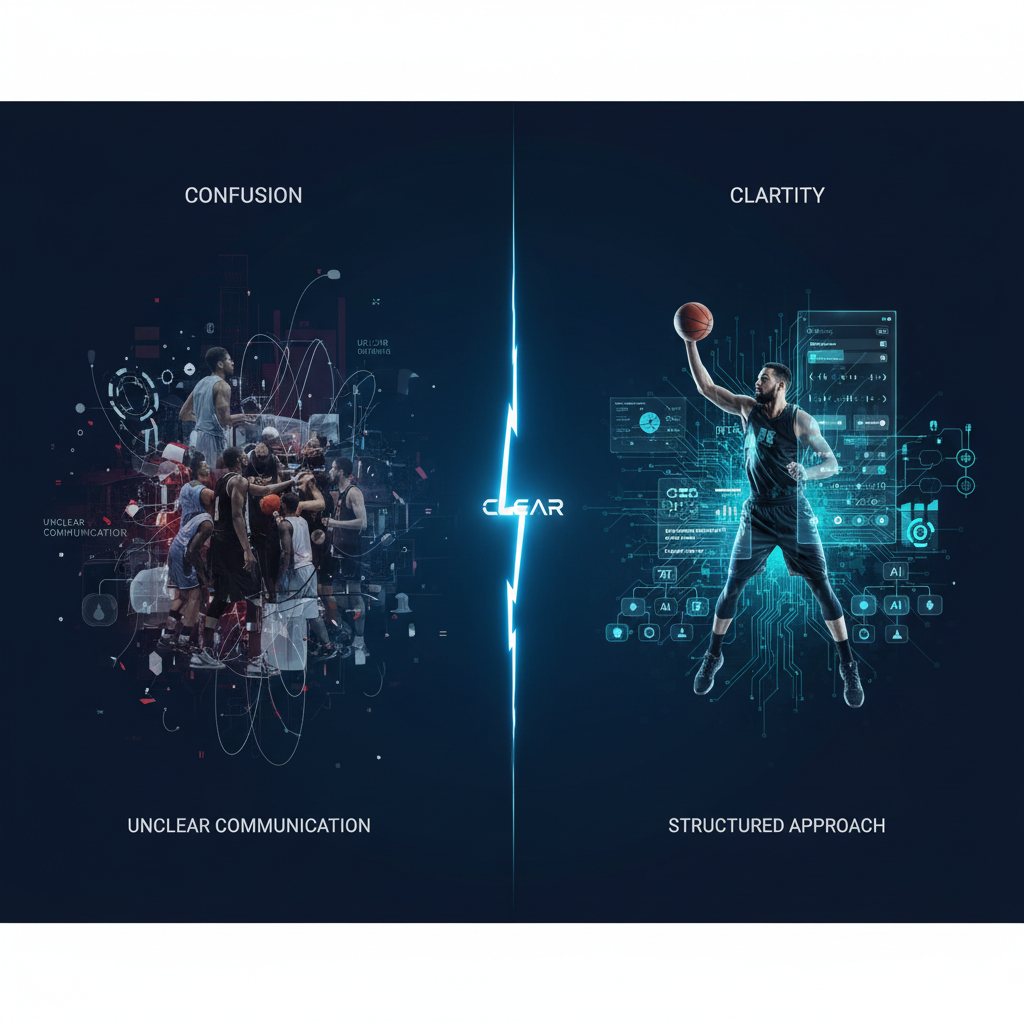
<p><strong>In the world of sports technology and artificial intelligence, clarity is rare.</strong></p>

<p>People talk about AI, but they rarely explain how to apply it.</p>

<p>People talk about analytics, but they rarely show how to operationalize it.</p>

<p>And people often talk about what they do without showing why it matters or how it helps anyone else.</p>

<p><strong>This is exactly why I use the research‑backed CLEAR framework.</strong></p>

<p>CLEAR gives sports leaders, coaches, executives, universities, and founders a simple structured way to understand the value I bring to the ecosystem. It keeps everything grounded in logic, examples, adaptability, and results. And importantly, <strong>it removes ego from the conversation and replaces it with structure.</strong></p>

<p><strong>Read the full CLEAR breakdown:</strong> <a href="#using-clear-to-understand-the-value-rashad-west-brings-to-sports-technology-and-ai">Jump to the evaluation</a></p>

<div class="text-center my-4">
  <img src="/assets/images/blog-img/clear-intro-sports-ai.jpg" alt="Sports Technology and AI Intersection" class="img-fluid" />
</div>

<hr />

<h2 id="a-brief-background-on-the-clear-methodology"><strong>A Brief Background on the CLEAR Methodology</strong></h2>

<p>CLEAR is a research‑backed communication and problem‑solving framework used in business, engineering, and elite performance environments. It is not my proprietary approach; it is a well‑established, evidence‑informed method that I apply to sports technology and AI contexts.</p>

<p><strong>It forces complete thinking before execution.</strong></p>

<p><strong>It ensures everyone understands the objective, the context, the constraints, and the desired outcome.</strong></p>

<p>CLEAR stands for:</p>

<p><strong>Clarity</strong></p>

<p>Define what the real problem is and what needs to be solved.</p>

<p><strong>Logic</strong></p>

<p>Explain the reasoning and the systematic approach behind the solution.</p>

<p><strong>Examples</strong></p>

<p>Show real world demonstrations and past work that prove capability.</p>

<p><strong>Adaptation</strong></p>

<p>Shift and evolve based on changing conditions without losing direction.</p>

<p><strong>Results</strong></p>

<p>Demonstrate measurable outcomes that define success.</p>

<p>CLEAR works because it:</p>

<ul>
  <li>Forces complete thinking before starting</li>
  <li>Gives AI and stakeholders all the necessary context</li>
  <li>Establishes clear success criteria</li>
  <li>Reduces unnecessary back and forth</li>
  <li>Ensures consistent high quality results</li>
</ul>

<p><strong>It is not just a framework.</strong></p>

<p><strong>It is a lens.</strong></p>

<p>And a <strong>tool that allows the sports ecosystem to understand and evaluate the value I bring</strong> through a structured, unbiased process.</p>

<div class="text-center my-4">
  <img src="/assets/images/blog-img/clear-methodology-breakdown.jpg" alt="CLEAR Framework Methodology Breakdown" class="img-fluid" />
</div>

<hr />

<h2 id="what-clear-unlocks-for-your-team">What CLEAR unlocks for your team</h2>

<p>When we use CLEAR together, you can expect:</p>

<ul>
  <li>Faster clarity on scope, constraints, and success criteria</li>
  <li>Better decisions with less back-and-forth</li>
  <li>Examples that translate to evidence your stakeholders can evaluate</li>
  <li>Adaptation without chaos — what changes, why, and what it means</li>
  <li>Results that are measurable and tied to performance or business outcomes</li>
</ul>

<h2 id="using-clear-to-understand-the-value-rashad-west-brings-to-sports-technology-and-ai">Using CLEAR to Understand the Value Rashad West Brings to Sports Technology and AI</h2>

<h3 id="c---clarity-what-i-do-and-why-it-matters"><strong>C - Clarity: What I do and why it matters</strong></h3>

<p>Clarity begins with understanding that my work sits at the <strong>intersection of sports performance, AI engineering, product innovation, and automation architecture.</strong></p>

<p>My background is uniquely positioned for this:</p>

<ul>
  <li>Former professional basketball player with global experience</li>
  <li>Sports data scientist with over a decade working at the intersection of sports and technology</li>
  <li>Builder of early stage computer vision based sports analytics workflows focused on data automation and insight generation</li>
  <li>Builder of early stage VR and AR powered training prototypes designed for athlete learning and testing</li>
  <li>Currently testing a sports themed coding game to improve engagement and technical literacy through sport</li>
  <li>Led BTE Analytics through early innovation pilots with NBA teams, focused on learning, iteration, and applied value</li>
  <li>We are partnering with a University for Sports Analytics (Announcement coming soon)</li>
  <li>Partnered with Microsoft, Meta, NBA and NFL Alumni groups, and Techstars</li>
</ul>

<p>But my understanding of elite competition runs deeper than just my own experience.</p>

<p>Growing up, I competed alongside <strong>seven cousins in my age group who all went Division 1 in sports</strong> — four basketball, one football, one track, and one lacrosse. <strong>That competitive environment shaped how I understand performance, development, and what it takes to reach the highest levels.</strong></p>

<p><strong>I understand athletes because I was one</strong>, and because I competed with and against athletes who reached the highest levels across multiple sports.</p>

<p><strong>I understand systems because I build them.</strong></p>

<p><strong>I understand organizations because I have worked with them.</strong></p>

<p>Clarity here is simple.</p>

<p><strong>I bridge the gap between AI capability and sports performance reality.</strong></p>

<div class="text-center my-4">
  <img src="/assets/images/blog-img/clear-clarity-section.jpg" alt="Clarity: Intersection of Sports Performance and AI Engineering" class="img-fluid" />
</div>

<hr />

<h3 id="l---logic-why-my-skillset-creates-value-in-this-market"><strong>L - Logic: Why my skillset creates value in this market</strong></h3>

<p>Logic means <strong>looking at the reasoning behind why my experiences matter.</strong></p>

<ul>
  <li>Sports teams need custom AI workflows, not generic tools</li>
  <li>Universities need applied AI experts who can teach and build</li>
  <li>Startups need someone who understands both product and performance</li>
  <li>Companies need automation systems that reduce costs and increase reliability</li>
</ul>

<p>My resume shows this logical alignment:</p>

<ul>
  <li>Engineered autonomous n8n and MCP systems with ninety nine point nine percent reliability</li>
  <li>Built local infrastructure that eliminated cloud costs and improved speed</li>
  <li>Developed VR and AR sports applications</li>
  <li>Created the Ultimate Hoops training model used across multiple locations</li>
  <li>Evaluated sports and AI startups as a Senior VC Scout</li>
  <li>Built data governance, machine learning workflows, and cloud integrations</li>
</ul>

<p>The logic is straightforward.</p>

<p><strong>Every environment I have worked in is aligned with the AI transformation happening in sports today.</strong></p>

<div class="text-center my-4">
  <img src="/assets/images/blog-img/clear-logic-section.jpg" alt="Logic: Market Needs Aligned with Skillset" class="img-fluid" />
</div>

<hr />

<h3 id="e---examples-where-i-have-demonstrated-real-capability"><strong>E - Examples: Where I have demonstrated real capability</strong></h3>

<p><strong>Your value becomes unquestionable when you show real examples, not theories.</strong></p>

<p>Examples from your track record include:</p>

<ul>
  <li>Built early stage computer vision based sports analytics workflows focused on data automation and insight generation</li>
  <li>Built early stage VR and AR powered training prototypes designed for athlete learning and testing</li>
  <li>Currently testing a sports themed coding game to improve engagement and technical literacy through sport</li>
  <li>Led BTE Analytics through early innovation pilots with NBA teams, focused on learning, iteration, and applied value</li>
  <li>We are partnering with a University for Sports Analytics (Announcement coming soon)</li>
  <li>Engineered self correcting automation systems using n8n, MCP, and Claude</li>
  <li>Co created a Python dribble plot algorithm for NBA and NCAA analytics</li>
  <li>Developed AI powered tools for measurable athlete development</li>
  <li>Trained over two hundred athletes using integrated technology systems</li>
  <li>Built partnerships with Microsoft, Meta, NBA and NFL Alumni groups</li>
</ul>

<p>These are not hypothetical examples.</p>

<p>They are product, engineering, education, and performance wins across multiple ecosystems.</p>

<div class="text-center my-4">
  <img src="/assets/images/blog-img/clear-examples-section.jpg" alt="Examples: Real Work and Demonstrated Capability" class="img-fluid" />
</div>

<hr />

<h3 id="a---adaptation-how-i-adjust-and-evolve-in-changing-environments"><strong>A - Adaptation: How I adjust and evolve in changing environments</strong></h3>

<p><strong>Adaptation is one of my strongest advantages.</strong></p>

<ul>
  <li>Transitioned from pro basketball to data science</li>
  <li>Shifted from VR development to AI engineering</li>
  <li>Expanded from operations to automation architecture</li>
  <li>Worked across startups, enterprise partners, and universities</li>
  <li>Built systems that maintain themselves using Claude and MCP</li>
  <li>Built new AI infrastructure when cloud costs became inefficient</li>
</ul>

<p>Adaptation matters in AI and sports because conditions change fast.</p>

<p><strong>I evolve even faster.</strong></p>

<div class="text-center my-4">
  <img src="/assets/images/blog-img/clear-adaptation-section.jpg" alt="Adaptation: Evolution and Career Transformation" class="img-fluid" />
</div>

<hr />

<h3 id="r---results-what-measurable-outcomes-i-consistently-deliver"><strong>R - Results: What measurable outcomes I consistently deliver</strong></h3>

<p><strong>Results are where everything becomes real.</strong></p>

<p><strong>Highlights: 99% reliability, 40% faster development, $100K+ raised.</strong></p>

<ul>
  <li>Ninety nine percent automation reliability on MCP and n8n systems</li>
  <li>Forty percent reduction in development time using Claude based automated maintenance</li>
  <li>Over one hundred thousand dollars raised for BTE analytics product and programs</li>
  <li>Trained more than two hundred athletes with technology integrated systems</li>
  <li>Built sports performance programs used at multiple facilities</li>
  <li>Achieved moving from VC Scout to Senior VC Scout within one month</li>
  <li>Scaled partnerships with Microsoft, Meta, NBA team, and NFL Alumni</li>
</ul>

<p><strong>These results speak for themselves.</strong></p>

<p><strong>They show impact, not intention.</strong></p>

<div class="text-center my-4">
  <img src="/assets/images/blog-img/clear-results-section.jpg" alt="Results: Measurable Outcomes and Impact" class="img-fluid" />
</div>

<hr />

<h2 id="why-clear-shows-i-am-the-right-partner-for-sports-technology-solutions"><strong>Why CLEAR Shows I Am the Right Partner for Sports Technology Solutions</strong></h2>

<p>When you use CLEAR to evaluate my background, <strong>the conclusion becomes obvious.</strong></p>

<p><strong>Clarity</strong> shows the intersection I sit in.</p>

<p><strong>Logic</strong> explains why my skillset is needed today.</p>

<p><strong>Examples</strong> demonstrate my actual work.</p>

<p><strong>Adaptation</strong> proves I evolve with the industry.</p>

<p><strong>Results</strong> show measurable impact.</p>

<p>And here is the key.</p>

<p><strong>This same CLEAR process can be used as an AI prompt engineering tool to evaluate any sports technology need.</strong></p>

<p>When teams, schools, or companies run CLEAR on their challenges, it becomes clear where I fit in and how I can help.</p>

<p><strong>This is not about ego.</strong></p>

<p><strong>It is about structure.</strong></p>

<p><strong>It is about clarity.</strong></p>

<p>It is about <strong>giving the sports ecosystem a way to understand how AI can create real value.</strong></p>

<h2 id="try-clear-on-your-challenge">Try CLEAR on your challenge</h2>

<ul>
  <li>Want a quick pass? Request a 15‑minute walkthrough of how CLEAR applies to your team.<br />
<a href="/contact">Contact me</a></li>
  <li>Prefer to self‑serve? Ask for the one‑page template to run CLEAR on your next project.<br />
<a href="/contact">Request the template</a></li>
  <li>Already know the problem? Share it and I’ll map a CLEAR‑based plan you can execute internally or with me.<br />
<a href="/contact">Start here</a></li>
</ul>

<div class="text-center my-4">
  <img src="/assets/images/blog-img/clear-conclusion-partnership.jpg" alt="Partnership: CLEAR Framework for Sports Technology Solutions" class="img-fluid" />
</div>]]></content><author><name>Rashad West</name></author><category term="Insights" /><category term="AI" /><category term="sports-tech" /><category term="CLEAR-framework" /><category term="value-proposition" /><category term="communication" /><category term="automation" /><category term="sports-analytics" /><summary type="html"><![CDATA[How the CLEAR framework helps sports leaders, coaches, executives, and founders understand the value I bring through clarity, logic, examples, adaptation, and results.]]></summary></entry><entry><title type="html">Why I Built a Local Server to Run 24/7</title><link href="https://sportstechwest.com/blog/Why-I-Built-a-Local-Server-to-Run-24-7/" rel="alternate" type="text/html" title="Why I Built a Local Server to Run 24/7" /><published>2025-10-29T00:00:00+00:00</published><updated>2025-10-29T00:00:00+00:00</updated><id>https://sportstechwest.com/blog/Why-I-Built-a-Local-Server-to-Run-24-7</id><content type="html" xml:base="https://sportstechwest.com/blog/Why-I-Built-a-Local-Server-to-Run-24-7/"><![CDATA[<h2 id="why-i-built-a-local-server-to-run-247">Why I built a local server to run 24/7</h2>

<p>I wanted to build a system that keeps working even when I’m not. The goal was simple: automate the repetitive parts of my day so I can focus only on high-value decisions.</p>

<p>That’s what led me to create a local server that runs nonstop. This wasn’t about experimenting with tech — it was about freeing my time and mental space. When the busy work runs itself, I stay locked in on growth, strategy, and creativity.</p>

<hr />

<h2 id="what-i-wanted-to-fix">What I wanted to fix</h2>

<p>Before, my automations only worked when my laptop was on.</p>

<p>If I weren’t connected, everything stopped — blogs, emails, workflows, images.</p>

<p>Now, everything runs automatically:</p>

<ul>
  <li>Docker spins up my MCP servers</li>
  <li>Notion and Glif manage my content pipeline</li>
  <li>n8n keeps backend automations running continuously</li>
</ul>

<p>No downtime. No waiting. No dependency on me.</p>

<hr />

<h2 id="what-runs-while-i-sleep">What runs while I sleep</h2>

<p>Here’s what’s live 24/7:</p>

<ul>
  <li><strong>Notion MCP</strong>: Organizes, updates, and publishes content</li>
  <li><strong>Glif MCP</strong>: Generates images for my blog posts automatically</li>
  <li><strong>n8n</strong>: Handles workflows like email automation, scheduling, and analytics</li>
</ul>

<p>Everything runs locally, not in the cloud. It’s private, fast, and completely under my control.</p>

<div class="text-center my-4">
  <img src="/assets/images/blog-img/24-7-automation-workflows.jpg" alt="24/7 Automation Workflows" class="img-fluid" />
</div>

<hr />

<h2 id="why-local-matters">Why local matters</h2>

<p><strong>Real control</strong></p>

<p>I know what’s happening behind the scenes. Every service, every log, every process is visible and managed directly.</p>

<p><strong>Privacy by design</strong></p>

<p>My automations run on my network, not someone else’s. My data stays where it belongs.</p>

<p><strong>No monthly costs</strong></p>

<p>I’m not paying for servers that sit idle. My Mac was already running — now it’s working for me 24/7.</p>

<p>This isn’t about being anti-cloud. It’s about truly understanding and owning the systems that run my business.</p>

<div class="text-center my-4">
  <img src="/assets/images/blog-img/24-7-server-comparison.jpg" alt="Before and After: Cloud vs Local 24/7" class="img-fluid" />
</div>

<hr />

<h2 id="how-it-works">How it works</h2>

<p>My Mac runs Docker around the clock. Each service runs in its own container.</p>

<ul>
  <li>Notion MCP handles content automation</li>
  <li>Glif MCP powers image generation</li>
  <li>n8n runs daily workflows</li>
</ul>

<p>Everything starts automatically when the machine boots. If a container crashes, it restarts. A UPS keeps things stable during power dips.</p>

<p>The setup is lightweight, reliable, and doesn’t need babysitting.</p>

<div class="text-center my-4">
  <img src="/assets/images/blog-img/24-7-server-architecture.jpg" alt="24/7 Server Architecture Diagram" class="img-fluid" />
</div>

<hr />

<h2 id="what-this-changes">What this changes</h2>

<p>Now my mornings start with results, not resets.</p>

<p>I’m no longer checking logs — I’m reviewing output.</p>

<p>This setup gives me two huge advantages:</p>

<p><strong>Clarity:</strong> I know exactly what’s running and why</p>

<p><strong>Focus:</strong> I spend time on the things that move the business forward</p>

<p>Automation isn’t just about saving time. It’s about freeing your focus so you can make better decisions.</p>

<hr />

<h2 id="the-bottom-line">The bottom line</h2>

<p>I built a 24/7 server so I could stay focused on what matters. The system runs the repetitive work so I can run the business.</p>

<p>This is what real leverage feels like — automation that doesn’t need permission, attention, or activation.</p>

<p>True automation keeps going whether you’re online or not. That’s what efficiency and ownership really look like.</p>

<p>The 24/7 server is my learning platform. It’s my automation foundation. It’s my private infrastructure.</p>

<p>And it runs whether I’m there or not.</p>

<p>That’s the point.</p>

<div class="text-center my-4">
  <img src="/assets/images/blog-img/the-bottom-line-new.jpg" alt="The Bottom Line - 24/7 Server" class="img-fluid" />
</div>]]></content><author><name>Rashad West</name></author><category term="Insights" /><category term="server" /><category term="automation" /><category term="docker" /><category term="24-7" /><category term="local" /><category term="infrastructure" /><category term="mcp" /><summary type="html"><![CDATA[Why I decided to build my own always-on infrastructure for automation, AI workflows, and continuous learning — and why it changed everything.]]></summary></entry><entry><title type="html">Local Email Automation: From Inbox to Action for Client Workflows</title><link href="https://sportstechwest.com/blog/Local-Email-Automation-For-Client-Workflows/" rel="alternate" type="text/html" title="Local Email Automation: From Inbox to Action for Client Workflows" /><published>2025-10-28T00:00:00+00:00</published><updated>2025-10-28T00:00:00+00:00</updated><id>https://sportstechwest.com/blog/Local-Email-Automation-For-Client-Workflows</id><content type="html" xml:base="https://sportstechwest.com/blog/Local-Email-Automation-For-Client-Workflows/"><![CDATA[<h2 id="how-i-built-an-ai-assistant-that-handles-my-emails-but-still-asks-permission">How I built an AI assistant that handles my emails (but still asks permission)</h2>

<p>Imagine having a really smart intern who reads your emails, drafts thoughtful replies, and then asks, “Do you want me to send this?”<br />
That’s what I’m building, except the “intern” is AI, and it runs on my own computer.</p>

<p>For me, this isn’t just about automation. It’s about <em>understanding</em> how AI thinks, how it learns patterns, and how I can use that understanding to build systems that think <em>with</em> me, not <em>for</em> me.</p>

<hr />

<h2 id="why-this-matters-for-sports-and-innovation">Why this matters for sports and innovation</h2>

<p>In sports business, the inbox never sleeps:</p>

<ul>
  <li>Partnership inquiries</li>
  <li>Media requests</li>
  <li>Sponsor communications</li>
  <li>Fan engagement</li>
  <li>Event coordination</li>
</ul>

<p>Most replies follow patterns, but every message still needs a human touch. My system handles the pattern work automatically and keeps me firmly in control.</p>

<p>That control is key. Every time I teach AI to handle one more layer of work, I learn more about how intelligence can be trained, not just to save time, but to scale creativity. This same understanding powers how I’m building <strong>BallCode</strong>, my AI sports language that turns movement into logic and creativity into code.</p>

<hr />

<h2 id="the-workflow">The workflow</h2>

<ol>
  <li>An email hits my inbox.</li>
  <li>AI reads it and figures out the intent.</li>
  <li>AI drafts a response in my voice.</li>
  <li>AI sends the draft to me: “Should I send this?”</li>
  <li>I approve, edit, or reject.</li>
  <li>Only then does it actually send.</li>
</ol>

<p>The key: I’m still the decision-maker. The AI is just really fast at drafting.<br />
It’s not replacing my judgment. It’s giving me space to think more deeply and respond more strategically.</p>

<p><em>Note: I tested this system extensively on my personal email before deploying it to my main inbox. Safety first, especially with automation.</em></p>

<div class="text-center my-4">
  <img src="/assets/images/blog-img/n8n-email-workflow.jpg" alt="n8n email automation workflow" />
</div>

<hr />

<h2 id="the-tech-setup-plain-english">The tech setup (plain English)</h2>

<ul>
  <li><strong>n8n:</strong> Like Zapier or IFTTT, but I own it. It’s open-source and runs locally on my Mac. It connects apps and automates workflows.</li>
  <li><strong>Claude AI:</strong> The “brain” that reads emails and writes responses. Advanced, reliable, and adaptable.</li>
  <li><strong>MCP connection:</strong> The new bridge that lets Claude not just suggest changes, but actually <em>make</em> the changes to my automations.</li>
</ul>

<p>The setup isn’t just technical. It’s educational. Each step is teaching me how modern AI systems think, how they interpret context, and how they can safely take action on my behalf.</p>

<div class="text-center my-4">
  <img src="/assets/images/blog-img/claude-mcp-n8n-setup.jpg" alt="Claude AI, MCP, and n8n architecture diagram" />
</div>

<hr />

<h2 id="the-messy-middle-what-i-had-to-figure-out">The messy middle: what I had to figure out</h2>

<p>Early on, building and fixing automations felt like assembling LEGO while wearing mittens. Whenever something broke, I had to:</p>

<ul>
  <li>Click through menus</li>
  <li>Find the right setting</li>
  <li>Make a change</li>
  <li>Test it</li>
  <li>Repeat</li>
</ul>

<p>It was slow. Really slow.<br />
But that struggle is part of the process. Each mistake helped me understand not just the tool, but the logic behind how AI sees a task, breaks it down, and learns to fix it.</p>

<hr />

<h2 id="the-breakthrough-mcp-as-the-bridge">The breakthrough: MCP as the bridge</h2>

<p>I connected Claude to my local automation using MCP (Model Context Protocol). Now Claude can:</p>

<ul>
  <li>See what’s broken</li>
  <li>Fix it automatically</li>
  <li>Test that it works</li>
  <li>Report back: “Done.”</li>
</ul>

<p>Before: “Hey Claude, my email workflow is broken.” I get a 10-step checklist.<br />
After: Same message. Claude fixes it in seconds and shows me exactly what changed.</p>

<p>That’s when I realized this isn’t just about automating a process. It’s about <em>teaching AI how to maintain and improve itself</em> while I stay in the driver’s seat.</p>

<div class="text-center my-4">
  <img src="/assets/images/blog-img/n8n-mcp-breakthrough.jpg" alt="Before and after: MCP breakthrough showing slow manual fixes vs fast AI-powered automation" />
</div>

<hr />

<h2 id="setup-process-what-i-actually-did">Setup process (what I actually did)</h2>

<ol>
  <li>Generated an API key: Basically a backstage pass for Claude to talk to my automation.</li>
  <li>Built a small bridge program: A translator so Claude and n8n speak the same language.</li>
  <li>Configured Claude: Pointed it to my local system, added the API key, and connection details.</li>
  <li>Restarted everything: Fully quit and reopen. Don’t just close windows. It matters.</li>
</ol>

<p>Each line of code was like building a muscle. I wasn’t just setting up automation, I was <em>learning how intelligence moves through a system.</em></p>

<div class="text-center my-4">
  <img src="/assets/images/blog-img/gmail-consultation-new.png" alt="Gmail approval email showing paid consultation opportunity" />
</div>

<div class="text-center my-4">
  <img src="/assets/images/blog-img/gmail-consultation-2.png" alt="Gmail approval interface showing AI draft response" />
</div>

<div class="text-center my-4">
  <img src="/assets/images/blog-img/gmail-consultation-3.png" alt="Gmail approval step showing workflow in action" />
</div>

<hr />

<h2 id="real-time-visibility-slack-notifications">Real-time visibility: Slack notifications</h2>

<p>Every time my automation processes an email, I get a notification in Slack. It’s like having a dashboard that shows me exactly what happened, when it happened, and how the AI handled it.</p>

<p>The notification tells me everything I need to know:</p>
<ul>
  <li>Who the email was from and what it was about</li>
  <li>The priority score and confidence level</li>
  <li>Whether it was auto-sent or waiting for my approval</li>
  <li>A preview of the AI-generated response</li>
  <li>The exact timestamp of when everything happened</li>
</ul>

<p>This visibility is crucial. I’m not just automating my inbox. I’m building a system that teaches me how AI makes decisions. Each notification is a learning moment. I can see patterns in how the AI classifies emails, how it scores urgency, and how it structures responses.</p>

<p>The best part? It’s all happening locally. These notifications don’t go through any third-party service. They flow directly from my n8n workflow to my Slack workspace, giving me real-time insight into my automation without compromising privacy or control.</p>

<div class="text-center my-4">
  <img src="/assets/images/blog-img/slack-email-notification.png" alt="Slack notification showing email automation details and AI response preview" />
</div>

<hr />

<h2 id="real-use-cases-im-running">Real use cases I’m running</h2>

<ol>
  <li><strong>Partnership responses</strong>
    <ul>
      <li>Incoming: “Interested in exploring a partnership?”</li>
      <li>AI draft: Professional, curious, requests key details</li>
      <li>Me: Approve or personalize based on the sender</li>
    </ul>
  </li>
  <li><strong>Media requests</strong>
    <ul>
      <li>Incoming: “Can we interview you about [topic]?”</li>
      <li>AI draft: Checks my calendar, proposes times, keeps the tone on-brand</li>
      <li>Me: Approve or decline based on the outlet and topic</li>
    </ul>
  </li>
  <li><strong>Fan engagement</strong>
    <ul>
      <li>Incoming: General questions, feedback, shout-outs</li>
      <li>AI draft: Friendly, aligned with our voice</li>
      <li>Me: Quick review and send</li>
    </ul>
  </li>
  <li><strong>Event coordination</strong>
    <ul>
      <li>Incoming: Venue, logistics, timing</li>
      <li>AI draft: Pulls in our standard policies and preferences</li>
      <li>Me: Approve routine stuff; I handle exceptions</li>
    </ul>
  </li>
</ol>

<p>Every one of these cases teaches me something about language, tone, and intent. All lessons I can apply to future AI projects.</p>

<hr />

<h2 id="why-i-built-it-this-way">Why I built it this way</h2>

<ul>
  <li><strong>Privacy:</strong> Everything runs on my computer. No random cloud services touching my inbox.</li>
  <li><strong>Control:</strong> The AI never sends without my approval. It’s an assistant, not a replacement.</li>
  <li><strong>Customization:</strong> I own the stack. I can shape it around how I work, not how a SaaS product wants me to work.</li>
  <li><strong>Learning:</strong> As AI improves, my system improves with zero vendor lock-in.</li>
</ul>

<p>This isn’t just about efficiency. It’s about building <em>understanding</em>. By learning how AI interacts with my workflow, I’m learning how to build tools that can adapt, evolve, and scale with my creativity.</p>

<hr />

<h2 id="the-real-innovation">The real innovation</h2>

<p>Email automation isn’t new. The leap is giving AI the ability to build and fix its own automation.<br />
Instead of hiring someone for every tweak, I describe what I want and Claude does the heavy lifting.<br />
It’s like having a technical co-founder who never sleeps.</p>

<p>But the bigger breakthrough is what it’s teaching me.<br />
Each project like this sharpens my ability to design systems that are not only smart but human-aware tools that respect boundaries, context, and creativity.</p>

<hr />

<h2 id="whats-next">What’s next</h2>

<ul>
  <li><strong>Lead generation:</strong> AI identifies and drafts outreach to potential partners and sponsors.</li>
  <li><strong>Market intelligence:</strong> Monitors news and sends me what actually matters.</li>
  <li><strong>Meeting prep:</strong> Reads my calendar and builds one-pagers before calls.</li>
  <li><strong>Social media:</strong> Drafts posts in my voice, still with approval.</li>
</ul>

<p>Same principle: AI does the work. I make the calls.</p>

<p>The next evolution is connecting these systems: my AI assistant, BallCode, and future local agents into one intelligent network that learns <em>my rhythm.</em><br />
Every experiment like this gets me closer to that.</p>

<hr />

<h2 id="the-bottom-line">The bottom line</h2>

<p>We’re moving from “AI as a tool” to “AI as a partner.”<br />
For sports innovators, that means:</p>

<ul>
  <li>Faster execution on good ideas</li>
  <li>More time for strategy and relationships</li>
  <li>Less time on repetitive admin</li>
  <li>Better consistency across communications</li>
</ul>

<p>Understanding AI on this level changes everything.<br />
It’s not just about automation. It’s about developing a new kind of fluency.<br />
The more I learn how to <em>teach</em> AI, the more I can build tools that think, move, and create like me.</p>

<p>Everything here is local-first.<br />
The visuals above show the full workflow, approval steps, and the MCP bridge. You can see exactly how it all connects.<br />
Because innovation isn’t just about what you build. It’s about <em>what you learn while building it.</em></p>]]></content><author><name>Rashad West</name></author><category term="Insights" /><category term="automation" /><category term="email" /><category term="workflows" /><category term="local" /><category term="productivity" /><summary type="html"><![CDATA[How I built a private, in-house email automation system to streamline client ops and help friends and colleagues automate theirs.]]></summary></entry><entry><title type="html">Building AI Agents to Teach Blockchain (Because Why Not?)</title><link href="https://sportstechwest.com/blog/Building-AI-Agents-to-Teach-Blockchain/" rel="alternate" type="text/html" title="Building AI Agents to Teach Blockchain (Because Why Not?)" /><published>2025-10-25T00:00:00+00:00</published><updated>2025-10-25T00:00:00+00:00</updated><id>https://sportstechwest.com/blog/Building-AI-Agents-to-Teach-Blockchain</id><content type="html" xml:base="https://sportstechwest.com/blog/Building-AI-Agents-to-Teach-Blockchain/"><![CDATA[<div class="text-center my-4">
  <img src="/assets/images/blog-img/New_Defi_Image_new.jpg" alt="AI Blockchain Education" class="img-fluid" />
</div>

<p>Lately, I’ve been experimenting with some fun ideas — mainly using <strong>AI agents built with n8n</strong> to share quick, easy-to-digest lessons about <strong>blockchain, crypto, and DeFi</strong> with a small group of friends.</p>

<p>We all know this stuff is the future, but it can be confusing to dive into. So instead of scrolling through endless crypto threads or trying to decode tech talk, I figured, why not let automation do the heavy lifting?</p>

<hr />

<h2 id="enter-n8n-automation-made-simple">Enter n8n: Automation Made Simple</h2>

<p>That’s where <strong>n8n</strong> comes in. It’s an open-source tool that lets you build automated workflows. I set up some AI agents that push bite-sized blockchain explainers, crypto updates, and DeFi concepts right into our group chat.</p>

<div class="text-center my-4">
  <img src="/assets/images/blog-img/defi_blog2.png" alt="n8n Workflow" class="img-fluid" />
</div>

<p>Basically, it’s like having a nerdy friend who never stops sending you interesting stuff — except this one doesn’t sleep or forget.</p>

<p>Each AI agent can tweak what it shares based on what people actually like or engage with. If someone’s into NFTs, it’ll send more NFT breakdowns. If another person wants to understand staking, it adjusts for that too.</p>

<hr />

<h2 id="learning-made-fun">Learning Made Fun</h2>

<p>The whole point isn’t to teach blockchain like a classroom — it’s just to make learning <strong>fun and effortless</strong>.</p>

<div class="text-center my-4">
  <img src="/assets/images/blog-img/defi_blog1.jpg" alt="Blockchain Learning" class="img-fluid" />
</div>

<p>We get to learn together, talk about new ideas, and actually understand what’s shaping the digital future instead of just hearing the buzzwords.</p>

<p><strong>Learn a little. Automate a lot. Have fun doing it.</strong></p>

<p>That’s pretty much the vibe of this mini AI + blockchain experiment.</p>

<p>And honestly, it’s been a great way to stay curious and explore what’s next — together.</p>

<div class="text-center my-4">
  <img src="/assets/images/blog-img/Play-to-Earn_Defi_BLog.jpg" alt="Play to Earn DeFi" class="img-fluid" />
</div>]]></content><author><name>Rashad West</name></author><category term="Insights" /><category term="AI" /><category term="blockchain" /><category term="automation" /><category term="n8n" /><category term="DeFi" /><category term="education" /><summary type="html"><![CDATA[Using AI agents built with n8n to share quick, easy-to-digest lessons about blockchain, crypto, and DeFi with friends — making learning fun and effortless.]]></summary></entry></feed>